The New MCDP Constitution Sets Forth Big Pro-Democracy Goals For The Democratic Party County Organization

Glad to see that the MCDP Constitution approved last year at the June MCDP Reorganization Meeting has, at last, been posted on the MCDP website. It’s great that Kurt Hatcher, the new MCDP Executive Director, is bringing the website up-to-date.
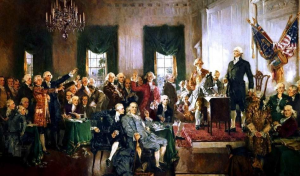
The signing of the United States Constitution at Independence Hall in Philadelphia on September 17, 1787.

The new MCDP Constitution sets forth some big pro-democracy goals for the Democratic Party county organization:

  • The new preamble says that the MCDP should seek to be “a strong party organization that empowers representative democracy within our party and throughout the county.”
  • The new statement of purpose says: “The purpose of the Montgomery County Democratic Party is to represent and to serve Montgomery County Democrats. The MCDP advances this purpose by connecting Montgomery County Democrats within an extended MCDP community where every member has a voice, and by advancing candidates of the people who are dedicated to public service, and whose values align with the principles of the Democratic Party.”

Another big pro-democracy change included in the new constitution is the name of the MCDP organization. As indicated in the expired MCDP Constitution, the established name for the organization was “The Montgomery County Democratic Central Committee.” The new name is “The Montgomery County Democratic Party.” This is a huge difference. The old name indicated that the MCDP was an exclusive group — the membership of the Central Committee. The new name is more inviting. The new constitution calls for the creation of a MCDP organization, with membership open to all Montgomery County Democrats. Members of the Central Committee would be participants and leaders in this larger group.

The new MCDP preamble / statement of purpose set the MCDP apart from Ohio’s other 87 Democratic party county organizations. The new MCDP Constitution establishes a mission and statement of purpose that, if followed, will result in the transformation of the MCDP organization. It provides a powerful foundation for building an exemplary 21st Century Democratic Party organization in this county.

I wrote the first draft of the preamble and statement of purpose. Members of the Constitution Committee, chaired by Mark Owens, made minor changes but pretty much accepted my wording. The newly elected Central Committee, at the June, 2018 Reorganization Meeting, without debate affirmed the recommendation of the Constitution Committee and the new preamble and statement of purpose were included in the finalized MCDP Constitution.

I started making posts on this website in 2007. It has been a useful journal, a record. The following are excerpts from previous posts that relate to the development of this preamble and statement of purpose:

Imagining A Transformed Montgomery County Democratic Party — It’s A Systems’ Problem, February 18th, 2014

The purpose that should animate the MCDP must be one that transcends simply winning elections. The purpose of MCDP that will inspire and motivate the action that is needed must be one that is more than simply acting as an advocacy group focused on marketing certain issues. We need to focus on something more fundamental. I believe we can find a source of motivation and civic action by focusing on democracy itself. The MCDP should see its transcending mission as promoting and empowering democracy. If we could actually fulfill such a mission — by educating the public, by facilitating opportunities for political participation, by creating community — then, of course, Democrats would win elections in droves.

Here is one suggestion for how the purpose / mission for the MCDP should be stated: To empower democracy to work in all aspects of Montgomery County.

To accomplish such a mission, the MCDP should encourage the growth of grass roots democratic structures throughout the county. Brainstorming what such structures might look like is the next step. For one thing, the MCDP, itself, should be structured as a democracy empowering organization. As I said in my DDN letter, “Democrats now are looking for a 21st century organization that is democratic and inclusive, and that welcomes them into a meaningful and connected community.” Not only Democrats would support such a transformed party, but such a party would have wide appeal to many who currently are disengaged from the whole political process.

Note To David Pepper: Go For the Big Win — Invite All Ohio Democrats To Become Voting Members Of The ODP, February 11th, 2015

The ODP is a political institution consisting of only 148 voting members. This small group stands apart from the Democratic base. In the 2014 May Democratic Primary, there were 1,307,000 Democrats who voted. These active Democrats are the ODP “Infrastructure” and success for the party depends a lot on whether this group is “energized.” Very few of these Democrats feel they have any voice within the Democratic Party. To energize this base we need to expand opportunity.  We need to reimagine the Ohio Democratic Party as an extended Roberts Rules online community of Democrats who commit to working together, to listening and communicating with each other, and to making positive impacts in their local communities. Even a participation of only 10% of those voting in the last Democratic Primary would bring 130,000 Democrats into community, but even a start of only 10,000 would be very energizing. I’d like to see changes in the ODP Constitution so that:

  • Any Ohio citizen that votes in two Democratic primaries is invited to become a voting member of the ODP and a full participant in the ODP website.
  • Every four years the state leadership, the state party chair, via an online convention, is elected directly by the entire expanded ODP membership.
  • An “Executive Committee,” chosen through election, determines many issues but for some key questions, the entire expanded ODP membership is invited vote.
Message to Tom Perez: The Democratic Party Is An Oligarchy — It Must Reorganize and Be “The Party of The People”, March 6th, 2017

Here is a daring thought: Suppose the Democratic Party becomes dedicated to actually being the party of the people. Right now, the notion that we are the party of the people is contradicted by the fact that the Democratic Party is still organized like the Republican Party — as a “political boss,” oligarchic system. In Ohio our party chairmen, David Pepper, was elected by a committee of 148 insiders — only 66 members of the group were directly elected in a Democratic Primary — regardless that 1.3 million Ohio Democrats regularly vote in Primaries. It’s pretty laughable that the Ohio Democratic Party wants to send every Ohio Democrat who donates money to the ODP a “membership card,” but this card gives the holder no vote, no say-so, in the party organization.

Rather than saying, “The DNC’s mission has to be to elect people up and down the ballot,” I’d like the leader of the party to emphasize that the DNC’s mission is to strengthen the structure of our democratic republic. I’d like to hear our leader say that political parties have a big role to play in empowering citizens so that their government is truly of the people, for the people and that the Democratic Party is changing its organization structure so that ordinary Democrats are in charge of the party — not the insiders, not the big-money people.

Oligarchy was once defended as the only practical method of making decisions because difficult transportation and slow methods of communication hindered the effective use of large groups. But now, Ohio could have a Democratic Party of thousands or hundreds of thousands of individuals all connected through the internet and this party could function as an on-line deliberative democracy.

Imagining A Twenty-First Century Democratic Party, October 23rd, 2017

To imagine a 21st century Democratic Party is to realize that the Democratic Party has a huge responsibility to produce the leaders of extraordinary character and wisdom that will help bring us to our best future.

We need a 21st Century Democratic Party built on this mission: To prepare and to elect leaders who are of the people and who demonstrate exceptional leadership skills and civic virtue.

Such leaders emerge from a bottom-up, grassroots process, rather than a top-down hierarchical process.
They are known by their connection and service to meaningful broad-based communities and by their capacity to deal with conflicting points of view to find an avenue for consensus.

I like the TV ads for “Buddy” the carpet salesman who declares, “We don’t want to make money, we just love to sell carpet.” The 21st Century Democratic Party we need is one that can say, “We just love to make the system of representative democracy work as it is suppose to work.” By focusing on making the system work as it should, Democrats will be elected in droves.

Montgomery County Democrats Should Debate Competing Visions Of The Future of The MCDP Organization, December 7th, 2017

We need to build a local Democratic Party that is structured as a 21st century grassroots organization. Such an organization would effectively use technology to advance its mission. Its organizational structure would be flat rather than pyramidal. It would generously empower its members with leadership opportunities. It would re-frame its purpose and mission so that inspires and thrills the youth.

In my view, the party must put its confidence in this premise: When democracy wins, Democrats win.  We need to focus on democracy winning. Our purpose as a party should be defined as electing individuals to public office who are of the people and for the people.  As a party we need to walk the walk and structure ourself as an inviting deliberative democracy — the party of the people, the party that empowers the people, the party that works to build harmony and community.

The MCDP Must Transform Its “Political Boss” Structure — To Engage / Empower Loyal Democrats, April 3rd, 2018

MCDP Reorganization must address the fact that regardless that the county has about 60,000 Democrats — maybe 3% of whom periodically work for Democratic campaigns — only a tiny percentage of county Democrats are engaged in the party organization (maybe one-half of one percent). Many loyal Democrats have never been inspired to be engaged in the MCDP. How can MCDP be reorganized to engage and empower loyal Democrats?

Looking honestly at the present MCDP structure is to recognize the traditional “political boss” organizational structure that emerged from the nineteenth century — yes, the nineteenth century. At one time this system was effective, but now it is not working and has not worked for some time. What made it effective at one time was the elaborate system of patronage that empowered local party leaders to reward party workers with all kinds of government jobs. At one time, some Democrats were eager to work for the party because they hoped to get a patronage job. The power of patronage that supported the political boss system has largely vanished, but the system remains.

The Big Hairy Audacious Goal that The Montgomery County Democratic Party Should Focus On: “We Choose To BE BEST” Jan 9, 2019

Request for Proposal: The Very Model Of a Modern MCDP

The MCDP, the controlling committee for the Democratic Party in Montgomery County, is in need of a five year plan for system transformation. The Montgomery County Democratic Party seeks a plan that will implement the ideals affirmed in our MCDP Constitution and will, over time, transform the MCDP into the Democratic county organization that is widely considered the best organized and most successful in the nation, one that other county organizations will want to emulate. The MCDP is seeking to become the very model of the best that a Twenty-first Century Democratic Party county organization can be.

The MCDP is accepting proposals in response to this RFP in order to find a qualified source to write a five year plan that shows a vision of a fully actualized MCDP and shows the steps and process for bringing that vision to reality.

Posted in Local/Metro | 1 Comment

The In-Depth Discussions And Planning That The Central Committee Of The MCDP Should Have

This is a draft of a note I intend on sending to some members of the MCDP Central Committee

Mark Owens, Chairman of the Montgomery County Democratic Party and Clerk of Courts

I’m looking forward to working together with you this year as a fellow member of the Montgomery County Democratic Party Central Committee. I know you agree with me that we need to insist that the Central Committee become a legitimate legislative group, not the rubber stamp that it is famous for being.

If we are to be effective Central Committee members, we need to be well-informed. I wonder if you would support a motion to ask the chairman to take responsibility for generating reports and for scheduling discussion in the Central Committee on the following topics:

  1. The MCDP finances and budget over the last five years and goals and plans for the next several years.
  2. A breakdown of the 2018 Democratic campaign in Montgomery County. Some questions:
    What was the ODP role?
    How much money did the ODP spend, and on what?
    What was the MCDP role?
    How much money did the ODP spend, and on what?
    What worked and what didn’t work?
    Why was turn-out in strong Democratic precincts so low and how can this turn-out be improved?
  3. Plans for generating the strongest possible candidate for the open seat in OHD-39 in 2020 — since Fred Strahorn is term-limited.
  4. Plans for finding and encouraging Democrats to seek election to local city councils and school boards.
  5. Plans for making the work of the Central Committee transparent to all interested Montgomery County Democrats.

I feel that the Democratic Party should do everything possible to become known as the “pro-democracy” party. The place to start is at the grassroots — the county level — and the MCDP needs to walk the walk. In a pro-democracy MCDP party organization, the Central Committee — along with all interested county Democrats — would be fully engaged and fully informed in the work and decisions of the MCDP.

Let me know what you think. — Mike

P.S. There is a pro-democracy faction in the MCDP and then there is the pro-status-quo faction that has been in control for many years. Members of this pro-status-quo faction personally benefit from the traditional political boss structure, even though it has resulted in a very weak party organization.

Even if our pro-democracy faction is small, say 30% of the total group, we have more influence than our numbers suggest. The leaders in the MCDP are also elected county officials — Clerk of Courts, County Auditor, etc — their names periodically must appear on the ballot of a Democratic Primary. Mark Owens has chosen to not only hold an elected public office, Clerk of Courts, but also to be the Chairman of the MCDP. Karl Keith the county auditor plays a big role in the MCDP, so does Matt Heck and Nan Whaley. Because these leaders in the MCDP are also elected officials, I feel they have a special responsibility to be “pro-democracy” in their actions in the MCDP.  Because they have a lot of control in party, they have a special responsibility to show that the party is fair and that the system is not rigged. These elected officials, it seems, would want to agree that the Central Committee — along with all interested county Democrats — should be fully engaged and fully informed in the work and decisions of the MCDP.

Posted in Local/Metro | Leave a comment

Will The MCDP Learn From The Winburn / Harris Contest And Choose The Strongest Candidate — Not The Strongest Insider?

Victor Harris with Governor Ted Strickland at MLK Day in Dayton, 2008.

In 2008, Democrats controlled two Montgomery County House Districts, OHD-39 and OHD-40. After redistricting in 2012, OHD-40 became OHD-43, with lots of Republicans added from Prebble County. The Democrats retained two districts for one more House term. But in 2014, incumbent Roland Winburn lost in a rough race with Republican, Jeff Rezabek.

Winburn was first elected to the Ohio House in 2008 and at the time, he got the job because he was the choice of the MCDP insiders. If there had been an even playing field in Democratic Primary in 2008, Victor Harris would have won. It seems likely that, given the opportunity, in 2014 Victor would have defended the OHD-43 seat much more forcefully than Roland was able to do. It seems likely that if Victor had been elected in 2008, he would have amassed a more progressive record in Columbus than Roland was able to do.

Roland Winburn was very well liked in the MCDP. His friends who pushed his candidacy would say things like “It’s Roland’s turn,” or, “Roland has done so much for this party.” Fred Strahorn was term limited. In 2008, OHD-40 became an open seat and everyone knew that whoever would win the Democratic Primary would be a shoo-in for the general election. The MCDP Screening Committee brought the motion to the Central Committee to endorse Roland well before the deadline for Primary petitions to be submitted to the Board of Elections. There were OHD-40 Democrats who were still getting signatures on their petitions. The goal of the MCDP establishment was to coerce all candidates — except Roland — to drop out of the Democratic Primary and to not file petitions with the Board of Elections. Potential candidates were threatened that disobeying the party’s wishes would harm the chance for future opportunities in the party.

Retired OHD-43 Representative, Roland Winburn, and County Auditor Karl Keith

As it turned out, one Democrat — a newcomer to the region, Victor Harris — defied the party bosses and kept his name on the ballot. Victor’s defiance motivated a big push-back from the party insiders. Amazing, to me, was the huge effort extended by the MCDP to maintain its absolute authority to appoint buddies to plum positions. The MCDP raised a lot of money for Roland and activated a lot of volunteers — and sent every registered Democrat in the district a voter card telling them to vote for Roland. When the votes were counted Roland Winburn beat Victor Harris by 56% to 44%.

In 2010, Victor didn’t make a second attempt and Winburn had zero competition in the Democratic Primary. In the general election, Winburn got 72% of the vote. After the 2010 census, OHD-40 became OHD-43 and it was clear that OHD-43 would be a more competitive district. Roland won re-election in OHD-43 in 2012, but with the low voter turn-out in 2014, Roland lost to Rezabek.

I like Roland and twice I’ve donated money to his campaigns. I’ve got to think, however, that if Victor Harris had won the nomination in 2008, OHD-43 would have remained Democratic.

History repeats. Fred Strahorn once again is being term-limited in a strong gerrymandered Democratic House District — OHD-39. In 2020, OHD-39 will be an open seat. Will The MCDP Learn From The Winburn / Harris Contest And Work To Find The Strongest Candidate — Not The Strongest Insider?


  • Montgomery County Republicans Take Action That Effectively Suppresses Grassroots Democracy (July 20, 2007)  From a DDN editorial: “The leadership of the Republican Party — at both the local and state levels — is doing everything possible to avoid primaries, on the grounds that intra-party contests sap resources from the general election. … This will give the party leadership the opportunity to encourage the candidates who aren’t endorsed to seek other, lower offices and it will discourage contributors from giving money to people who aren’t going to be campaigning with the party’s blessing. … Setting aside the timing of the party meetings, the Republicans aren’t proceeding in a noticeably different way than the Democrats would. The Democrats , too, have districts that they dominate. (They are actually more dominant in them, because the Republican map-drawers have tried to concentrate Democratic voters in as few districts as possible.) And the party typically picks its own candidates and gets them nominated and elected easily.”
  • The Montgomery Democrats Decide to Suppress Democracy — Just Like the Republicans (December 14th, 2007) The central issue is not who to choose to endorse. The central issue is how to suppress the primary process. … Candidates have been waiting on the party’s endorsement and, because of the party’s endorsements last night, most un-endorsed candidates simply will drop out and will not make an effort to run as un-endorsed primary candidates. …What this process should be called is a process of discouragement. The Party simply doesn’t want more than one Democratic candidate in each primary race. And therefore, all potential candidates, other than one, are discouraged from filing. It is really sort of amazing.
  • The Dayton Daily News Criticises “Lackluster” Dems — Endorses Victor Harris for March 4 Democratic Primary (February 8th, 2008)  The Dayton Daily News today in an article entitled, “Our Recommendation: Harris offers Democrats much needed life,” endorsed Victor Harris as their choice for Democratic candidate for the 40th District Ohio House seat. The primary to determine who will represent Democrats in the 40th District is March 4. Roland Winburn is also seeking the Democrats’ nomination. … Particularly significant about the DDN’s endorsement of Harris is the fact that Harris is not the officially endorsed candidate of the Montgomery County Democratic Party. Winburn was officially endorsed by the Montgomery County Democratic Party and, at the time, the Democratic Party discouraged Harris from filing to run. But Harris decided to buck the party and decided to file regardless that he did not have official party support.
  • Victor Harris: Surprised That Local Democratic Party Wanted To Suppress Primary Competition (February 25th, 2008)  As early as last July, and certainly by September, the decision as to who should be the endorsed Democratic candidate for the 40th House District was already determined. The choice was Roland Winburn — not because all possible candidates had been fairly vetted, but because key players in the local Party decided that it was Winburn’s turn. … Winburn, a dignified and reasonable man, I feel, would be a reliable bureaucrat who would faithfully vote Democratic and would be accessible and responsive to his constituents. But what Victor Harris offers is much more. It is not appropriate for a few power players in the local Democratic Party to deny voters in the 40th District the right to decide. It seems very obvious to me that the position taken by the Montgomery County Democratic Party to suppress primary competition is untenable. It is not a position that most Democratic voters support.

  • DDN Gives Harris Two New Strong Endorsements; Democratic Insiders Attend Winburn’s Fund Raiser (February 29th, 2008) The DDN says, “Winburn waited his turn, but seems to have spent considerably less time thinking about what he might actually do to represent the district.” …The DDN, in praising Vic Harris, took a deserved slap at the Montgomery County Democratic Party. Mark Owens and the entire local Democratic Party leadership have a lot of explaining to do. …
  • The Empire Strikes Back: The Ohio Democratic Party Spends Big Bucks on Lieberman and Winburn (March 2nd, 2008)  In the 40th Ohio House District the state Democratic Party is distributing a full color, great looking handbill urging 40th District Democrats to vote for Roland Winburn. The headlines say that Roland is the “Endorsed Democrat,” and that “Democrats Endorse Roland Winburn for State Representative.” … The handbill includes the boxed statement, “Paid for by the Ohio Democratic Party, Chris Redfern, Chairman.” …The $50,000, or so, that the state machine is pouring into Montgomery County for Winburn and Lieberman is wasted money. This money should be used to help elect Democrats in marginal Districts.
  • How Gerrymandering Defeated An Outstanding Candidate And Sent a Weak Candidate To Columbus (March 5th, 2008)   Vic Harris lost to Roland Winburn for the 40th OHD Democratic nomination yesterday by 44% to 56%. I noticed that some voters walking through the parking lot in the rain to the polling place were clutching their Democratic Party Endorsed Candidate slate in their hands. … What gripes me is that many people voting for Winburn were simply wanting to be good Democrats and felt that the way to be a good Democrat was to follow the Party’s endorsement. … Because of gerrymandering, the Party has a monopoly in the 40th OHD. Because of gerrymandering, the Party knew it could play insider politics, and could advance a weak candidate, rather than a strong candidate, without the fear of penalty.
  • Mark Owens Says Most Montgomery Dems Approve The Party’s Suppression Of Primary Participation (April 8th, 2009)   …Mark was gracious and said that he was glad to discuss the matter and that, in his judgment, the County Party’s endorsement of Winburn over Harris, in fact, was not an antidemocratic action — because the Selection Committee and the Central Committee were chosen democratically and made their decisions democratically. Truly, a breathtaking defense. I pointed out that in the old Soviet Union, the Politburo also decided issues by voting. … Mark agreed that Vic Harris is well qualified to represent the 40th OHD in the State Assembly, but, Mark said that the Selection Committee members resented the fact that Vic was a newcomer, who hadn’t paid his dues to the party; they felt Vic hadn’t worked his way up in the organization, but, felt, on the other hand, that Winburn deserved endorsement because he had contributed a lot to the local party.
Posted in Local/Metro | Leave a comment