Yale Study Reports That Most Tea Party Members Deny That Global Warming Is Real

One big reason our fractured society finds it difficult to arrive at the consensus needed to address big problems is that there is a disagreement about basic facts, a big disagreement about what constitutes reality. The dispute over basic facts is particularly obvious on matters of science, particularly with disagreement with the scientific community’s findings concerning global warming. Many of the deniers of science have coalesced within the newly formed “Tea Party.”

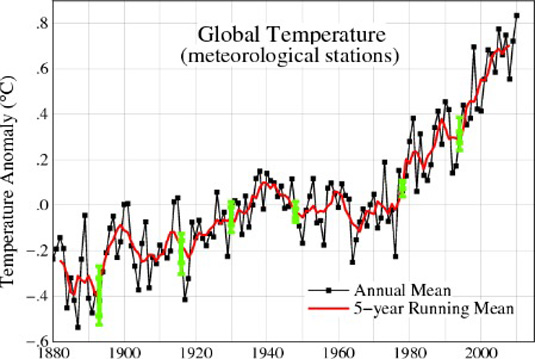
The chart below shows meteorological readings over the last 120 years that shows global warming is real. Yet there are thousands of people who dispute this basic fact.

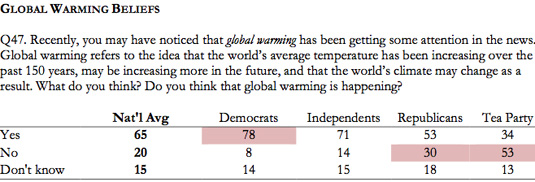
A Yale University study, “Politics and Global Warming,” published earlier this year, based on in-depth interviews with 809 people shows a big division among political groups: “Majorities of Democrats (78%), Independents (71%) and Republicans (53%) believe that global warming is happening. By contrast, only 34 percent of Tea Party members believe global warming is happening, while 53 percent say it is not happening.”

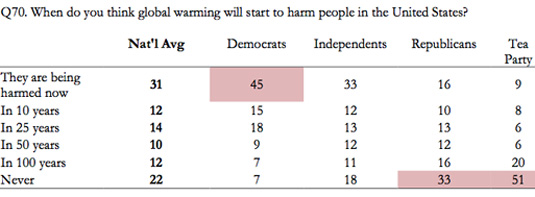
Of course, if you don’t think global warming is happening, you have no reason to think there is any danger that global warming will lead to any harm:

Nearly half of Democrats (45%) say that global warming is already harming people in the United States, while 33 percent of Republicans and 51 percent of Tea Party members say it will never harm people in the United States.

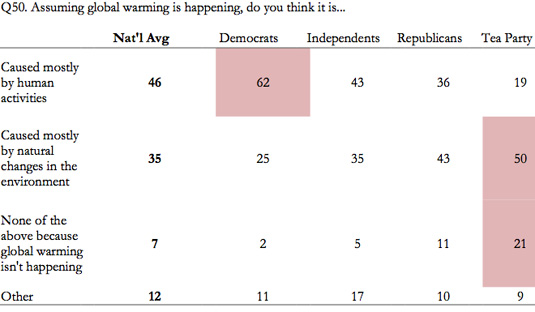
The big question, if global warming is real, then, what is causing global warming?


While 62 percent of Democrats say that global warming is caused mostly by human activities, most Tea Party members say it is either naturally caused (50%) or isn’t happening at all (21%).

Other Findings of the Yale Study:

  • A majority of Democrats (55%) say that most scientists think global warming is happening, while majorities of Republicans (56%) and Tea Party members (69%) say that there is a lot of disagreement among scientists about whether or not global warming is happening.
  • A large majority of Democrats (72%) worry about global warming, compared to 53 percent of Independents, 38 percent of Republicans, and 24 percent of Tea Party members. Over half (51%) of Tea Party members say they are not at all worried about global warming.
  • Tea Party members are much more likely to say that they are “very well informed” about global warming than the other groups. Likewise, they are also much more likely to say they “do not need any more information” about global warming to make up their mind.
  • Majorities of Democrats, Independents and Republicans support requiring electric utilities to produce at least 20% of their electricity from renewable energy sources, even if it cost the average household an extra $100 a year. A majority of Tea Party members, however, oppose this policy, with 39 percent strongly opposed.
  • Likewise, majorities of Democrats, Independents and Republicans support an international treaty to cut carbon dioxide emissions. A large majority of Tea Party members, however, oppose a treaty, with 55 percent strongly opposed.
  • Majorities of Democrats and Independents support paying 5% more on their monthly utility bill to get their electricity from renewable sources, changing zoning rules to promote energy efficient apartment buildings, mixed use neighborhoods to encourage walking, and decreasing suburban sprawl. Majorities of Republicans and Tea Party members oppose these local policies, with Tea Party members much more likely to strongly oppose them.
  • Tea Party members are more than twice as likely than any other group to say they don’t want to change the light bulbs in their house to energy-efficient compact fluorescent lights (CFLs).
  • Democrats are more likely to believe that human beings evolved from earlier species of animals (62%), compared to Independents (57%), Republicans (51%), and Tea Party members (34%).

See related posts:


Posted in Special Reports | 5 Comments

It Is The Truth That Makes Us Laugh — Why “Simple Math” Might Help Obama Get Re-Elected

The laughter of Republican congressman last night during President Obama’s speech seemed spontaneous. It didn’t sound to me like a laughter of derision, but honest laughter. What makes us laugh, sometimes, is a sudden revelation of the truth. The universe is a pretty funny place. We laugh at words that tell it like it is.

After pointing out that “Warren Buffet pays a lower tax rate than his secretary – an outrage he has asked us to fix,” Obama proceeded to outline a truth that made the Republicans laugh:

Should we keep tax loopholes for oil companies? Or should we use that money to give small business owners a tax credit when they hire new workers? Because we can’t afford to do both. Should we keep tax breaks for millionaires and billionaires? Or should we put teachers back to work so our kids can graduate ready for college and good jobs? Right now, we can’t afford to do both.

This isn’t political grandstanding. This isn’t class warfare. This is simple math. These are real choices that we have to make. And I’m pretty sure I know what most Americans would choose. It’s not even close. And it’s time for us to do what’s right for our future.

It’s the truth we don’t want to admit that makes us laugh. Maybe Obama’s “simple math,” and the Republican’s refusal to deal with its reality, will be what makes the difference in the 2012 election.

Posted in Special Reports | Leave a comment

Liberals Should Co-Opt And Celebrate The Term, “American Exceptionalism”

I’m hoping that Ben Zimmer of Vocabulary.com saw the big Republican debate last night and will write a word analysis similar to his June 23 article, “Early Words from the Campaign Trail.”

I missed the debate, and I’m wondering if key words like “exceptionalism” or “declinist” were used. I like the title of the book “You are what you speak.” As candidates try to define themselves and their opponents, their choice of words is very revealing.

Republicans want to paint President Obama as a “declinist” — someone who believes that something, a country or system, is “undergoing a significant and possibly irreversible decline.” Republicans accuse Obama of being a “declinist” who is an “anti-exceptionalist” who, and another term, “leads from behind.”

Michele Bachman has said, “President Obama’s own people said that he was leading from behind. The United States doesn’t lead from behind. As commander in chief, I would not lead from behind. We are the head. We are not the tail.”

You can almost hear the crowd chanting, “U.S.A. … U.S.A.”

“American Exceptionalism” is a term that, I betting, will have a lot of use before the 2012 election. The American Catholic web-site says,  “The favor of the lollipop this election cycle for the G.O.P. is ‘American Exceptionalism’. For anyone who watched numerous figures at the CPAC convention (as I did) knows this fact. Each Republican candidate will wave the American flag and try to be the most patriotic.”

Newt Gingrich has a book on the topic, “A Nation Like No Other: Why American Exceptionalism Matters,” and he has a movie on the topic as well, “ A City Upon A Hill.” A blurb promoting the movie says, “America is a unique nation, and stands above all others because of that uniqueness. Unfortunately, President Obama wants to move America to more of a European style of democracy. From Egypt to France, President Obama has been on an apology tour telling global leaders that America is just one of many exceptional nations.”

Texas in this last controversial rewriting of the history curriculum, for the first time, mandated “American Exceptionalism” be included in school textbooks.  One of the proponents explained,  “The United States is an exceptional nation. Most Americans would not regard that as a controversial statement. And there is good reason for that: it is true.”

I agree. But the debate should be centered on what it is that makes America great. In my view, liberals should define “American Exceptionalism” in a way worthy of a progressive tradition and not allow the right wing to claim the term for its own exclusive use.

The right wing’s use of the term seems typified by a recent Wall Street Journal article by the Hoover Foundation intellectual, Shelby Steele, “Obama and the Burden of Exceptionalism,” that, posing as an exercise in thoughtfulness, was a one-sided trashing of the president.  It starts, “Mr. Obama came of age in a bubble of post-’60s liberalism that conditioned him to be an adversary of American exceptionalism.” It claims Obama has advanced, “an assault on America bedrock exceptionalism of military, economic and cultural pre-eminence.”

The article seems wildly popular with the WSJ readers — so far it has generated 951 comments.

A presidential campaign is an opportunity to have thoughtful discussion about the big ideas encapsulated in big terms. Yes, there is a lot of “denialism” in America. How else can we tout “American exceptionalism,” when, according to one government study, 59 million Americans lacked health insurance last year, and over 40 million Americans were living in poverty?

I know, the argument from the WSJ crowd is that “exceptionalism” is all about individual freedom, big stick military, etc., and if you can’t find a decent job, maybe it’s because you didn’t try hard enough to pass Algebra when you were a teenager. And if you are living in poverty it must be because you are too lazy to work.

According to a recent poll, 58% of Americans agree with the statement, “God has granted America a special role in human history.”

Liberal thinkers and writers, it seems to me, should not dispute “American exceptionalism,” labeling it “triumphalism,” or “dominionism.” Instead, let’s celebrate the fact that America, in fact, is unique and that, in fact, the God of the New Testament has a special role for America. The idea of “American Exceptionalism” should be a term that liberal writers and politicians should co-opt, should celebrate, and make their own term.

America is exceptional because America has a constitution that can evolve, and has evolved over time, to meet new challenges, so that the government can move ever closer to being “of the people, for the people.” The founding fathers would have hated the 16th Amendment empowering progressive taxation, would have hated women and blacks voting. So what? We evolved. This capacity to grow, to improve, toward an ever more perfect union — toward more justice, more freedom — is at the heart of American exceptionalism.

Let’s celebrate the ideals of America that makes us a “shining city upon a hill,” the ideals of “freedom and justice for all” we are still working to bring to reality, the ideals that make us a good example to the world.  Let’s celebrate the term “American Exceptionalism,” and define it in a way that is worthy of our ideals.

Posted in Special Reports | 13 Comments