Liberals Should Co-Opt And Celebrate The Term, “American Exceptionalism”

I’m hoping that Ben Zimmer of Vocabulary.com saw the big Republican debate last night and will write a word analysis similar to his June 23 article, “Early Words from the Campaign Trail.”

I missed the debate, and I’m wondering if key words like “exceptionalism” or “declinist” were used. I like the title of the book “You are what you speak.” As candidates try to define themselves and their opponents, their choice of words is very revealing.

Republicans want to paint President Obama as a “declinist” — someone who believes that something, a country or system, is “undergoing a significant and possibly irreversible decline.” Republicans accuse Obama of being a “declinist” who is an “anti-exceptionalist” who, and another term, “leads from behind.”

Michele Bachman has said, “President Obama’s own people said that he was leading from behind. The United States doesn’t lead from behind. As commander in chief, I would not lead from behind. We are the head. We are not the tail.”

You can almost hear the crowd chanting, “U.S.A. … U.S.A.”

“American Exceptionalism” is a term that, I betting, will have a lot of use before the 2012 election. The American Catholic web-site says,  “The favor of the lollipop this election cycle for the G.O.P. is ‘American Exceptionalism’. For anyone who watched numerous figures at the CPAC convention (as I did) knows this fact. Each Republican candidate will wave the American flag and try to be the most patriotic.”

Newt Gingrich has a book on the topic, “A Nation Like No Other: Why American Exceptionalism Matters,” and he has a movie on the topic as well, “ A City Upon A Hill.” A blurb promoting the movie says, “America is a unique nation, and stands above all others because of that uniqueness. Unfortunately, President Obama wants to move America to more of a European style of democracy. From Egypt to France, President Obama has been on an apology tour telling global leaders that America is just one of many exceptional nations.”

Texas in this last controversial rewriting of the history curriculum, for the first time, mandated “American Exceptionalism” be included in school textbooks.  One of the proponents explained,  “The United States is an exceptional nation. Most Americans would not regard that as a controversial statement. And there is good reason for that: it is true.”

I agree. But the debate should be centered on what it is that makes America great. In my view, liberals should define “American Exceptionalism” in a way worthy of a progressive tradition and not allow the right wing to claim the term for its own exclusive use.

The right wing’s use of the term seems typified by a recent Wall Street Journal article by the Hoover Foundation intellectual, Shelby Steele, “Obama and the Burden of Exceptionalism,” that, posing as an exercise in thoughtfulness, was a one-sided trashing of the president.  It starts, “Mr. Obama came of age in a bubble of post-’60s liberalism that conditioned him to be an adversary of American exceptionalism.” It claims Obama has advanced, “an assault on America bedrock exceptionalism of military, economic and cultural pre-eminence.”

The article seems wildly popular with the WSJ readers — so far it has generated 951 comments.

A presidential campaign is an opportunity to have thoughtful discussion about the big ideas encapsulated in big terms. Yes, there is a lot of “denialism” in America. How else can we tout “American exceptionalism,” when, according to one government study, 59 million Americans lacked health insurance last year, and over 40 million Americans were living in poverty?

I know, the argument from the WSJ crowd is that “exceptionalism” is all about individual freedom, big stick military, etc., and if you can’t find a decent job, maybe it’s because you didn’t try hard enough to pass Algebra when you were a teenager. And if you are living in poverty it must be because you are too lazy to work.

According to a recent poll, 58% of Americans agree with the statement, “God has granted America a special role in human history.”

Liberal thinkers and writers, it seems to me, should not dispute “American exceptionalism,” labeling it “triumphalism,” or “dominionism.” Instead, let’s celebrate the fact that America, in fact, is unique and that, in fact, the God of the New Testament has a special role for America. The idea of “American Exceptionalism” should be a term that liberal writers and politicians should co-opt, should celebrate, and make their own term.

America is exceptional because America has a constitution that can evolve, and has evolved over time, to meet new challenges, so that the government can move ever closer to being “of the people, for the people.” The founding fathers would have hated the 16th Amendment empowering progressive taxation, would have hated women and blacks voting. So what? We evolved. This capacity to grow, to improve, toward an ever more perfect union — toward more justice, more freedom — is at the heart of American exceptionalism.

Let’s celebrate the ideals of America that makes us a “shining city upon a hill,” the ideals of “freedom and justice for all” we are still working to bring to reality, the ideals that make us a good example to the world.  Let’s celebrate the term “American Exceptionalism,” and define it in a way that is worthy of our ideals.

Posted in Special Reports | 13 Comments

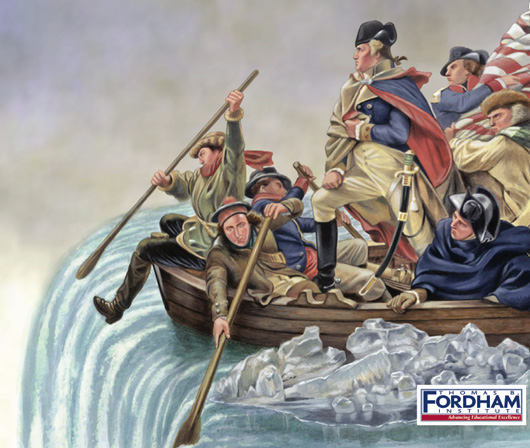
Schools Create “Dunderheads” — A Generation Of Students Ignorant Of U.S. History — Says Fordham

Analyzing how schools teach American History has long been a big emphasis for the Dayton based Fordham Foundation. The recent report published by the Foundation — The State Of U.S. History Standards 2011 — states: “We have mounting evidence that American education is creating a generation of students who don’t understand or value our own nation’s history. Dunderheads … one might well conclude, at least in this domain.”

Of all subjects, American students score lowest in American History, with only 20% of students showing proficiency on the National Assessment of Education Progress (NAEP).

The Foundation states: “Historical comprehension is vital if students are to understand their nation and world, and function as responsible, informed citizens,” and, deplorably low history scores, “remind us of the serious shortcomings in how we approach history education in this land. In the vast majority of states, history standards are pitiable and incentives to take this subject seriously are nonexistent.”

Schools are evaluated according to their math and reading scores, but scores in history have no impact on schools’ evaluation.

Fordham published a comprehensive analysis of American History education standards in 2003 and then, just this past February, in 2011. It rated Ohio’s American History curriculum standards a “D” in 2003, and, again, a “D” in 2011. It rated the history standards of only one state, South Carolina, an “A”. The average score for all fifty states was a “D”.

Concerning Ohio, the report states, “There is little American history content or educational rigor in Ohio’s standards. Before eighth grade, there is effectively none. The eighth-grade course offers a bit, attempting to cover the entire period in a handful of broad content statements. The high school course, while marginally more sophisticated, is still exceedingly brief and general; at best, it offers a very basic outline.”

The report quotes noted historian David McCullough: “I don’t think there’s any question whatsoever that the students in our institutions of higher education have less grasp, less understanding, less knowledge of American history than ever before. I think we are raising a generation of young Americans who are, to a very large degree, historically illiterate.”

From the report:

What causes this alarming vacuum of basic historical knowledge? There are multiple explanations, of course, but the most significant is that few states and school systems take U.S. history seriously. So why should students?

Yes, every state requires students to study American history in some form — often in the traditional junior-year U.S. history course — and every state except Rhode Island has mandated at least rudimentary standards for this subject. Yet few hold their schools accountable for teaching the standards or their students accountable for learning the content. In fact, it appears that only thirteen states include any history or social studies as part of a high school exit exam and just eight assess (or will soon assess) social studies or history at both the elementary and high school levels.

This under-emphasis on history in K-12 is compounded by the fact that universities seldom require prowess in history as a condition of entrance and almost never make it a graduation requirement of their own.

Since learning history doesn’t really count, schools devote less and less instructional time to it. One analysis, based on federal data, suggests that elementary schools spend a paltry 7.6 percent of their total instructional time on social studies, of which history is only one part — and often a distressingly small part.

The cover of the Fordham report, "The State Of U.S. History Standards 2011"

Posted in Special Reports | 4 Comments

Democrats Should Dump President Obama — And Nominate An Authentic Liberal Candidate

A Solon article, “What Democrats can do about Obama,” by Matt Stoller, says the fact that there is no primary challenge, as yet, to President Obama — regardless that “32% of Democratic voters would like to see a primary challenge” — shows there is a big failure of leadership in the party.  He says this failure shows how weak the Democratic Party is as a political organization.

I hope this Solon article will inspire a vigorous discussion in the Democratic Party, because, in my judgment, Democrats Should Dump President Obama And Nominate An Authentic Liberal Candidate.

Stoller is hoping that someone in the party eventually will show some gumption and he hopes the politics of 1892 might serve as a possible model.  In answer to the question, “So what can party leaders do?”, Stoller writes:

In 1892, the Democratic Party nominated Grover Cleveland, and with sweeping majorities in both houses, Democrats had control of the federal government for the first time since before the Civil War. Then a financial crisis, plus Cleveland’s stubborn allegiance to banking interests, turned his presidency into a catastrophe for Democrats.

When taking state candidates into account, the 1894 midterm elections were comparable to the 2010 wipeout; Cleveland was disliked so ardently that party leaders pushed him out of running for reelection. Instead the Democrats nominated William Jennings Bryan, who introduced many populist themes into the party and began the ideological transformation that would culminate with the election of Franklin Roosevelt in 1932.

Excerpts from the article:

  • On the economy, 71 percent of Americans disapprove of how Obama is doing his job. Even among reliably Democratic groups — union households, women and young people — he’s now unpopular.
  • No one, not even the president’s defenders, expect his coming jobs speech to mean anything. When the president spoke during a recent market swoon, the market dropped another 100 points.
  • Obama has ruined the Democratic Party. The 2010 wipeout was an electoral catastrophe so bad you’d have to go back to 1894 to find comparable losses. From 2008 to 2010, according to Gallup, the fastest growing demographic party label was former Democrat. Obama took over the party in 2008 with 36 percent of Americans considering themselves Democrats. Within just two years, that number had dropped to 31 percent, which tied a 22-year low.
  • The party’s responsibility is to actually choose the nominee best suited to win votes. If Obama looks unlikely to get enough votes to win, he should not get the nomination.
  • Obama’s failures have come precisely because he has not listened to Democratic Party voters. Obama continued idiotic wars, bailed out banks, ignored luminaries like Paul Krugman, and generally did whatever he could to repudiate the New Deal.
  • This is an institutional crisis for Democrats. …. If the economy worsens going into the fall, and the president continues as he has to attempt to cut Social Security, Democrats might be facing a Carter-Reagan scenario. Reagan, at first considered a lightweight candidate, ended up winning a landslide victory that devastated the Democratic Party in 1980. Carter wasn’t the only loss; many significant liberal senators, such as George McGovern, John Culver and Birch Bayh, fell that year.
  • Some organized constituency groups — say some components of the AFL-CIO — would need to announce that their support is up for grabs, based on a clear set of criteria.
  • What can change the reality of 2012 is if Richard Trumka, the president of the AFL-CIO, begins to take his job of representing workers seriously, and one or two establishment Democrats who remember liberalism decide to model courage for the younger generation. Then a robust debate can happen. Only by shaking up the current political order will solutions emerge.
  • Obama has basically endorsed every major plank of George Bush’s administration, yet Democrats still grant their approval.
  • Political parties need to be flexible enough to allow for new ideas to come into the process, or else third parties or civil disorder are inevitable. All it would take to provide this flexibility are well-known Democratic elders who understand that rank and file Democrats deserve a choice, and a few political insiders who realize that they can increase their own power by encouraging a robust debate. I don’t think this will happen. But just imagine if it did.


Posted in Special Reports | 2 Comments