Redistricting Drama In Columbus — Ohio Supreme Court Referendum Decision Pushes Assembly Action

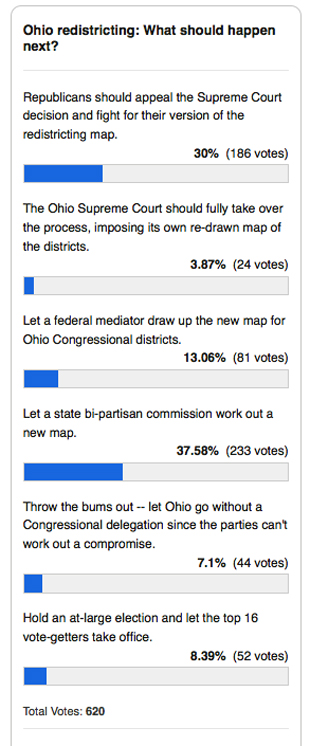
The results of a poll at Cleveland.com. I think the last choice -- an at-large election -- sounds interesting.

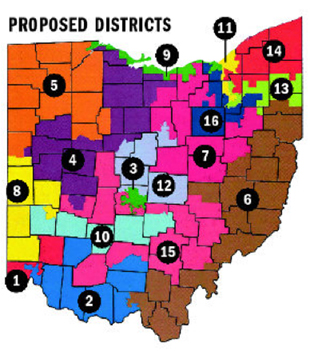
We can tear up the Ohio congressional redistricting map designed by Ohio Republicans and recently signed into law.

The Ohio Supreme Court has approved a referendum to be placed on the 2012 ballot to allow voters to abolish this map. Waiting for a 2012 referendum would cause such chaos, it seems likely that this Court decision will force Republican and Democratic leaders to allow a new map to be constructed via compromise. The process to determine how a new map will be drawn is being worked out this week in a high stakes drama now unfolding in Columbus.

To respond to the Supreme Court action, it appears that the first choice of Republicans is to pass “emergency legislation” that, according to the Ohio Constitution, would not be subject to referendum. Such legislation requires a two-thirds majority in both the House and Senate. In the House, 59 of the 99 members are Republicans, so, only seven Democratic votes are  needed for a new map to be approved by the necessary two-thirds majority. Republicans already have a two-thirds majority in the Senate.

It appears the first Republican strategy is to get votes from black Democrats in the House — by making a deal to arrange the map so that at least one more district could elect a black. Rep. Sandra Williams, a Cleveland Democrat who heads the Ohio Legislative Black Caucus says she has been contacted. “If the members of the caucus were interested, I would definitely entertain it,” she said. Williams said a black caucus meeting is scheduled for Wednesday where the topic is likely to come up for discussion.

It would seem unlikely that the black caucus would antagonize the Ohio Democratic Party by making a separate agreement with the Republicans. But, if a new map could gain the support of the black caucus, then this might push the Democratic leadership towards making a broader based deal.

The most likely outcome, it appears, is that the House Democrats will stick together and demand the formation of a bipartisan commission to work out a new map. A bipartisan commission is the first choice of those polled at cleveland.com. (See chart at left.)

It looks like the primary, now scheduled for March, will need to be moved to May or June. If a redistricting deal can’t be reached and the process for a referendum begins, the deadline for gathering signatures will be after the current December 7 deadline, so, if the process for a referendum is set in place, it appears certain that the primary will scheduled for a later date. And if a compromise process is agreed to, it appears the primary, also, will be set later, in order give candidates additional time in the new districts.

The map recently signed into law by Gov. Kasich makes 12 of Ohio's 16 congressional districts to be safely Republican -- although Ohio usually is about evenly divided in Republican and Democratic votes

Posted in Special Reports | 2 Comments

The Rise Of The Neocons — Romney At The Citadel — “A Speech Delivered By A Man On A Balcony”

Mitt Romney’s recent speech at the military school, The Citadel, revealed that “American Exceptionalism” likely would be a major theme of a Romney candidacy, with a campaign built around a slogan, “Believe In America.”

A “white paper” — AN AMERICAN CENTURY — A Strategy to Secure America’s Enduring Interests and Ideals — released in connection with the speech, makes clear that a big part of the campaign effort will be to belittle President Obama as an apologizer for America. It says,

“The sins President Obama has repented in our collective name are American arrogance, dismissiveness, and derision; for dictating solutions, for acting unilaterally, for acting without regard for others; for treating other countries as mere proxies, for unjustly interfering in the internal affairs of other nations, for committing torture, for fueling anti-Islamic sentiments, for dragging our feet in combating global warming, and for selectively promoting democracy. …A President who is so troubled by America’s past cannot lead us into the future.”

In contrast to Obama’s supposed apologies, in his Citadel speech, Romney declared, “I will not surrender America’s role in the world. This is very simple: If you do not want America to be the strongest nation on Earth, I am not your President. You have that President today.”

The white paper and the Citadel speech emphasized again and again that this century should be “An American Century,” using the same term that defined those advisers of George W. Bush, the designers of the preemptive Iraq War doctrine, known as “Neoconservatives.” As it turns out, Romney has recruited some of the same “American Exceptionalism” cheerleaders to work for his campaign.

If the Citadel speech is any indication, it is clear that a Romney candidacy will preach fear, fear, fear — and will attempt to make the case why a “USA. USA. USA” must acquire an even bigger military. “The American Conservative” calls itself, “The magazine for thinking conservatives,” and in response to the Citadel speech, Rod Dreher writes in “Romney’s Project For A New American Century” that the speech boils down to: “USA is No. 1! God commands us to be, for we are a chosen people, and if the rest of the world doesn’t like it, tough, we’ll do what we want to do to advance our mission of spreading our values universally.”

Dreher writes, “So it goes with Mitt Romney’s project for a new American century. It’s as if the Iraq War never happened, that there were no lessons to be learned from it. It’s as if Romney hadn’t noticed the dire fiscal straits our nation is in. Nothing here but stale old thinking (tip-off: using Cold War phrasing with “the free world”), rhetorical bombast, and implacable faith in the imperial project. None of this is surprising. It is all depressing.”

There are a lot of the interesting comments in response to Dreher’s post. I had to chuckle at the first one:

  • This isn’t foreign policy. This is a speech delivered by a man on a balcony…
  • It’s long been Mormon doctrine that the Constitution is “divinely inspired.” With this comes a heaping helping of American exceptionalism.
  • No candidate, in either party, who fundamentally disagrees with this American exceptionalism has any chance at a major-party nomination.
  • This speech doesn’t bother me in the least. Just more Romney pandering to get the red-state rednecks to vote for a guy from Massachusetts.
  • The neo-cons believe there remains a committed core of Republican activists who bought into the American Century project and believe it is only the defeatist, un-American Democrats that never have loved this country, who undermine morale, and keep us from the greatness that God intends us to have. This cadre may have been demoralized by the latter Bush years, but they remain the key to the nomination. They can be courted, and with the right words, convinced to believe once again.
  • I am astonished that the neo con perspective has not been utterly discredited. Their hubris, naiveté, ignorance and arrogance has cost this country plenty and I suspect those costs will play themselves out for a long time. Yet here we have their ideas being resurrected again. So discouraging.

Lawrence S. Wittner in “Romney’s Neocon Foreign Policy Plan”, writes, “One wonders what citizens and statesmen of other nations think of this potential world leader who argues that his country is confronted everywhere by malignant enemies, must forever be militarily supreme, is exempt from following international law, can do no wrong, has been created by God, and must dominate the planet for the rest of this century.”

Posted in Special Reports | 1 Comment

The Debate: “SB5 Is Reasonable Reform,” Argues Sen. Faber — “SB5 Is Wildly Extremist,” Says Dale Butlan

A recent debate concerning Ohio’s Senate Bill 5 featured two articulate experts sharply defining two opposing points of view. The video of the debate is copied below.

The question of the debate is whether SB5 should be sustained, as outlined in the statewide referendum, Issue 2, on the November ballot. Republican State Senator Keith Faber argued “Yes,” saying it provides a “reasonable reform” that will help the state and local governments. Innovation Ohio spokesperson, Dale Butland, argued, “No,” saying that SB5 is politically motivated, unnecessary, and is “wildly extremist.”

Interestingly, as the debate developed, Senator Faber, urging “Yes” to maintain SB5, quoted Democratic President Franklin Roosevelt to support his view, and Mr. Butland, urging “No,” quoted retired Republican Governor Voinovich to support his view.

The opening statements of the two speakers (transcript shown below) outlined the themes of the debate. Later in the debate Sen. Faber claimed that Columbus lost $40 million to pension pick-ups that SB5 would eliminate and that other communities also lost significant money. Mr. Butland’s retort was that much of the pension pick-ups go to school administrators who are not part of a union. He failed to address the $40 million claim, however.

Senator Faber: We Need Reasonable Reform To Turn Ohio Around. Vote “Yes.”

It was not long ago, just a few decades, that Ohio had more than 20 congressional districts. We just finished the redistricting process to go from 18 congressional districts to 16, and I think that summarizes probably more than any other statistic exactly what is happened in Ohio in the last few decades in relation to the rest of the country. One of the messages that is clear is that if we keep doing what we are doing and expect different results, then shame on us.

If we keep doing more of the same, business as usual, we will end up in ten years probably redistricting not for 16 congressional districts, but for 14. And Ohio’s place in the rest of the country will continue to be diminished. And that’s largely because of jobs and the state of Ohio’s economy. A major component, a major component, of turning that around is reforming the way Ohio and our local governments do business.

Senate Bill 5 is all about reasonable reform. Senate Bill 5 reforms are reasonable.

  • It is not unreasonable to ask government workers to pay 15% of the cost of their health care. It is not unreasonable to ask government workers to pay10% towards their very generous, guaranteed pensions.
  • It is not unreasonable to ask government workers to have their performance be a bigger dictator on their compensation than just how long they’ve sat in chairs.

The other thing, Senate Bill 5 is necessary. The reality is, we are out of money. As state and local governments, we are out of money. We can’t keep affording to pay for generous benefits for government workers that far exceed those of the private sector.

Senate Bill 5’s probably most important components deal with reclaiming our schools. It is important that in education we change the dynamic to improve the quality of education. This is an area where Barack Obama and conservative Keith Faber agree. We need to move towards performance based compensation and merit in the determination of the success of our public education.

Finally, Senate Bill 5, Issue 2, is all about protecting the taxpayers. It’s all about helping to insure that taxpayers have a seat at the table. For far too long, the people sitting at the table have been the unions, their union bosses and often the politicians the unions helped elect with their contributions. Taxpayers were left out. It’s time for us to level that playing field. It’s time for us to put taxpayers back at the table and not award government employee contracts with wages and benefits that taxpayers simply can’t afford. And what that’s led to is an overall reduction in the number of government employees. We’ve seen that in your community and we are seeing that all around Ohio.

Ultimately, I’m going to ask you for a “Yes” vote on Issue 2, and as we go through this debate I will ask you to try and separate the difference betwwen the facts from the hype and hyperbole. Let’s get to the facts

Mr. Butland rejected Sen. Faber’s argument saying, “None of these claims are true.” He tied SB5 into an overall Ohio Republican tax policy — benefiting the wealthy and needlessly maintaining costly tax loopholes — saying that the Republican tax policy has caused the crisis in state funding to local communities and schools and it is not true that overly generous wages and benefits to government employees should be blamed. Later in the debate, Butland developed the idea that the 1983 collective bargaining law benefited the state and resulted in fewer strikes by public workers. He quoted Republican George Voinovich’s comments defending and praising the 1983 legislation.

Dale Butland: SB5 Is Wildly Extremist, Political. Don’t Be Fooled. Vote “No”

Let me be very concise. Senate Bill 5 will hurt us all. It is unfair. It is unsafe. And, it is wildly extremist.

Senator Faber just told you that we need Senate Bill 5 because our state, our schools and local governments are out of money which he blames on overly generous worker wages and benefits. Senator Faber also told you that Senate Bill 5 won’t destroy collective bargaining, and if he didn’t tell you that in his opening, he will tell you that. He want us to believe it is only about a few reasonable reforms like asking public workers pay 10% of their pensions and 15% health insurance premiums.

Don’t let Sen Faber fool you. None of these claims is true. In Ohio, 94% of all public workers already pay the 10% of the pensions called for by Senate Bill 5. The 6%, who pay less than that 10%, don’t do so at their own request but at the request of their employers who sometimes find picking up some of that pension to be cheaper for them than raising wages. Roughly 90% of public workers contribute to health insurance. All state employees already pay the 15% for health insurance demanded by Senate Bill 5.

What about wages? Senator Faber didn’t tell you that over 90% of all contracts bargained this year contained a freeze on wages.

Even more to the point, schools and local government aren’t struggling because public workers have refused to sacrifice but because Governor Kasich and his allies, like Senator Faber, refused to close any of the $7 billion in tax loopholes we have on the books, and also refused to ask the wealthy Ohioans to make any sacrifices at all. Instead they chose to cut $ 3 billion from schools and instead cut local government by 50%. Here in Fairfield you lost $ 2.8 million.

As for bargaining, let’s get real. Under stage bill 5, collective bargaining would be gutted, and would exist in name only. It takes away the right to strike. It removes binding arbitration for safety forces who we aren’t allow to strike anyway. In cases where agreement can’t be reached it lets management to simply impose a its own contract offer, thereby removing any incentive to argue in good faith in the first place.

Public worker aren’t the only victims. It will will hurt you and your familes too. Let me close — If none of senator Faber’s works are true, why on earth would Governor Kasich impose such a law? Three words: power, politics and payback. And I’ll look forward to expanding on that in the debate ahead.


The Senate Bill 5 Debate starts at about the 1:33:00 mark

Posted in Special Reports | Leave a comment