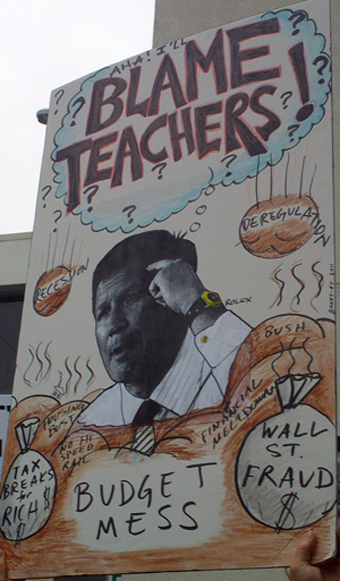
One of the many signs, yesterday, at the rally outside of the Dayton Convention Center
Ohio’s Senate Bill 5 is a bold move by Ohio Republicans to destroy public workers’ unions. This bill erases a lot of the Ohio Revised Code and completely destroys decades old procedures dealing with public employee contracts. It is incredible that legislation of this scope should be pushed through without a longer and more careful public debate. It seems a blatant power grab by Republicans who, after the last election, now have the upper hand.
South of Dayton Republican State Senator, Peggy Lehner, had an interesting request of teachers that was quoted in the DDN: “Help us (the State Assembly) figure out a system that blends merit with seniority. … To put the best possible teacher in the classroom should be your goal. It’s my goal and I’d like you to help me get there.”
Yes, I agree, we need a very different organizational structure for our system of public education. In my campaign to be elected to the Kettering School Board, I spoke of the need for “transformation,” and I believe transformation means radical change. But, in my view, this transformation, in order to be effective, must be a cooperative, long-term effort and the goal must be to raise and empower teacher professionalism. Nothing I see in Senate Bill 5 makes me think that this type of transformation is part of the Republican motivation.
This attack on public employee unions by Ohio Republicans parallels what is happening in Wisconsin. Paul Krugman writes that Republicans want to make America, “less of a functioning democracy and more of a third-world-style oligarchy.”
Stephen Lahanas writing on David Esrati’s blog makes this observation:
The current legislation being proposed by Gov. Kasich has absolutely NOTHING to do with Ohio. This is a coordinated effort across 14 states thus far and this latest strategy was developed by the CATO, Heritage Institutes over the past two years or so. Whatever complaints anyone here might have about unions locally or nationally, the goal of this effort has nothing to do with reforming current practices or even with budget shortfalls. The goal here is clear – to disempower all government services employees by breaking their unions. This is has been combined with a sustained propaganda attack in the media against teachers and state and federal employees (blaming teachers for all issues related to education, claiming state workers are overpaid etc.)”
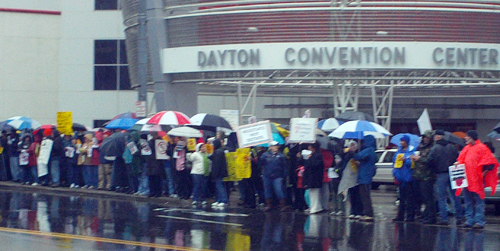
A big crowd -- at least 1000 -- chanted "Kill the Bill" at the Dayton Convention Center. Senator Peggy Lehner met with a group of teachers inside of the Center.
Lot’s of interesting comments — pro and con — at Cleveland.com:
- pogoaddict writes: “It is brain washed people LIKE YOU who do not realize that YOU and YOURjob will be next.Unless you own your own business or are a Millionaire everything thing that Unions do benefits YOU. Your pay is based on Union Scales. You work a 5 day work week because of Unions. You work in a safe environment because of Unions, you get vacation days because of unions, you get overtimes because of Unions. … I am truly sorry for all of you people who are so brain washed and brain dead you can not look at the facts and see that you are being lied to by the Republicans AGAIN.”
- larrylicious writes: “The unionthug leadership that relies on other peoples labor to support them in their upper middle-class lifestyles are worried that they may be out of a job. And well they should be. Maybe you should have been more careful with the dues money you collected instead of supporting Democrats 100% of the time. This shameful practice is coming to an end. Republicans are now in charge, and they are going to restore things to the way they should be.”
- lndep1 writes: “On a strictly political level, there’s a couple of reasons to listen to the safety unions. Unlike the teachers’ unions, AFSCME, and the SEIU, safety unions are not essentially an affiliate of the Democratic Party. They are much more politically independent. … One can understand why Republicans are hesitant to sit down with unions that always support Democrats, and contribute money and and other efforts to defeat Republicans. But that’s not the safety unions.”
- hoipolloi writes: “I support the proposed changes, but frankly I have no problem “slowing down” the process. The more people learn about this the more support it will have. Thevery concept of a public employee union is dubious — they create a fundamental unbalance at best and corruption of government at worst. The more it is talked about the clearer it becomes. And passing this bill after a convincing public debate is the best way for the change to be permanent.”
- Will_444 writes: “If we want to break up unions for first responders, teachers, and other government workers, why hide it in a fear-induced funding bill? We should have the guts to vote on a straight up/down bill to take away collective bargaining for workers. There may be more than one way to get through a budget crisis then on the backs of just one group of Ohio workers. The whole way this is set up in Ohio, Wisconsin, and other states seems too much of a political set-up.”