America’s Children Are Those Who Suffer Most From Cutbacks In State Government Spending

Paul Krugman, in his NYT article today, analyzes cuts in spending at the state and federal level and says, regardless that, “Advocates of big spending cuts often claim that their greatest concern is the burden of debt our children will face. In practice, however, when advocates of lower spending get a chance to put their ideas into practice, the burden always seems to fall disproportionately on those very children they claim to hold so dear.”

Krugman says Texas “seems to be where America’s political future happens first,” and Texas is closing its big budget gap by cutting funding to programs that help poor children.  He says, “While low spending may sound good in the abstract, what it amounts to in practice is low spending on children, who account for a large part of government outlays at the state and local level.”

Texas is proposing a 29% decrease in Medicaid and cuts to education that will require 100,000 layoffs of teachers and school workers.

The Center on Budget and Policy Priorities has analyzed the budgets of 36 states who have released their initial budget proposals for next year, and reports, “27 states plan to spend less in 2012, after inflation, than they did in 2008, and only two — Alaska and North Dakota — expect to spend significantly more.  Total proposed spending would be about 10 percent below 2008 inflation-adjusted levels.” (Ohio’s Gov. Kasich will not make his budget proposal until mid-March.)

  • At least 16 states have proposed identifiable, deep cuts in pre-kindergarten and/or K-12 spending.
  • At least 23 states have proposed identifiable, deep cuts in health care.  In Arizona, the governor’s budget would cut health care for 280,000 poor individuals.  Washington’s governor proposes eliminating affordable health care for more than 60,000 low-income residents.  Wisconsin’s governor also has submitted a plan to cancel health insurance coverage for about 70,000 people.
  • At least 15 states have proposed major, identifiable cuts in higher education.  Arizona would cut state support for public universities by one-fifth; when combined with previous cuts, this would reduce per-student state funding 46 percent below pre-recession levels.  California’s governor proposes to reduce funding for the state’s two university systems by $1 billion. For one of those two systems, the University of California system, the cuts would bring nominal spending down to the fiscal year 1999 level — when the system had 31 percent fewer students than it does today.
  • At least 14 states have proposed layoffs or identifiable cuts in pay and/or benefits for public workers.

Incredibly, additional tax cuts are planned in many states — and the revenue reduction from these additional tax cuts will lead to even more cuts in services to the poor and disadvantages.  The Center’s report on 36 states with recorded budgets states, “Some governors — about one in six — are proposing large tax cuts, mostly for corporations.” For example:

  • Florida’s governor proposes to cut the corporate income tax to 3 percent from 5.5 percent in the coming fiscal year — costing the state an estimated $459 million in fiscal year 2012 — and eliminate it by 2018.  On the spending side, the governor proposes very large cuts in education, health care and other areas …
  • New Jersey’s Governor Christie proposes a variety of tax cuts to begin in 2012, including reducing by 25 percent the corporate minimum tax paid by 93 percent of the state’s corporations and increasing to $1 million from $675,000 the amount that can be bequeathed to heirs tax-free. Taken together, these tax cuts will cost $200 million in fiscal year 2012; by 2016, the cost will have more than tripled to $700 million.  At the same time, Christie has proposed substantial pay decreases for state employees, applied for a waiver from federal Medicaid rules that likely would reduce significantly the number of people with access to the program, and other state spending cuts.

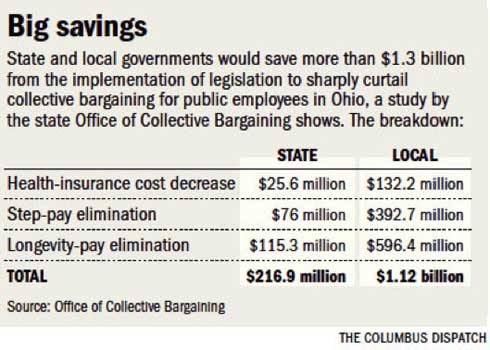
In Ohio, regardless of an $8 billion budget gap, Governor Kasish is pushing for a 4.2% reduction in the state income tax and an elimination of the state’s estate tax.

Posted in Special Reports | 5 Comments

Do Ohio’s Public Workers Earn More Than Private Sector Workers? — “No,” Says “Policy Matters Ohio” — “Yes,” Says “Americans For Prosperity”

In the discussion about Ohio SB5 — whether abolishing collective bargaining for Ohio’s public workers is a good idea — there is sharp disagreement as to whether Ohio public employees, at present, earn more than their private sector counterparts.

Two opposite groups have lined up:

  • Americans for Prosperity — an 501 C(4) group founded in large part by oil billionaires David and Charles Koch — urges passage of SB5 and says Ohio public employees make far more in wages and benefits than Ohio’s non-public workers in similar jobs. The State Director for Americans for Prosperity is Rebecca Heimlich. Here she explains to a group of supporters that Ohio needs collective bargaining “reform” because state workers make too much.
  • Opposing Americans for Prosperity is Policy Matters Ohio — an Ohio-based nonprofit, nonpartisan policy research organization funded by such groups as Sisters of Charity Foundation, the New World Foundation, the Annie E. Casey Foundation, the Heinz Endowment, the Open Society Institute, the Catholic Campaign for Human Development, KnowledgeWorks, the Public Welfare Foundation — urges defeat of SB5 and says that Ohio public employees make less in wages and benefits than Ohio’s non-public workers. The State Director of Policy Matters of Ohio is Amy Hanauer. I found no video of Ann speaking specifically about SB5, but here she discusses the goals of her organization.

On Americans for Prosperity web-site, I could find no explanation for Heimlich’s claim that public workers earn more in wages and benefits than their private worker counterparts.

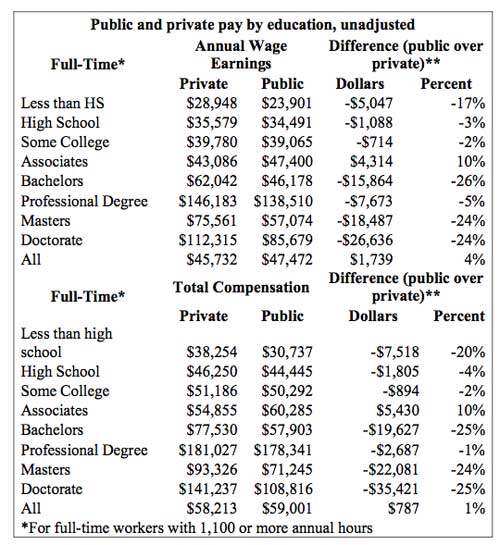
But at the Policy Matters web-site, there is a PDF of the testimony given by Hanauer in which she says, “We’ve worked with several top academic researchers nationally to understand public and private sector compensation in Ohio. The overwhelming conclusion is that public sector workers are, when we control for education and experience, compensated less well than private-sector workers.”

Here is a chart from that PDF:

Excerpts for Hanauer’s testimony:

  • Ohio’s budget problem is a revenue crisis, caused by a weak economy and ill- advised tax reductions that have deprived the state of needed revenue. Eliminating collective bargaining is not going to solve a revenue crisis.
  • Paying workers adequately and giving workers a voice in their workplace actually strengthens the economy. Workers who are reasonably well compensated create more stable communities, do not have as much need for public services, can build assets and spend locally and are better able to focus on and excel at their jobs.
  • The right of public workers to bargain collectively is not the cause of the budget shortfalls and eliminating that right to collective bargaining has not fixed the problem in states that have tried it. Deeper issues –investment, capital markets, trade and currency – are what shape regional economies.
  • States with no collective bargaining rights for any public employees saw an average budget shortfall of 24.8 percent in 2010 while states (including the District of Columbia) with collective bargaining for all public employees had an average budget shortfall of 24.1 percent. For the 42 states (and the District of Columbia) with some (or all) collective bargaining rights for some (or all) public workers, the 2010 budget deficit averaged 23 percent. These numbers are all very close. The right of public workers to unionize is not driving the state revenue or fiscal crisis.
  • On an annual basis, full-time state and local public employees earn lower wages by 5.7% in Ohio, in comparison to otherwise similar private sector workers in similarly-sized organizations (100 or more employees). When comparisons are made for differences in annual hours worked, full-time state and local employees are paid 3.1% less in Ohio.
  • Considering both the cost of employer-provided benefits and direct wages, public-sector workers in Ohio earn less than they would in the private sector.
    A standard earnings equation produced what some may feel is a surprising result: Ohio full-time state and local employees are paid 6.1% less. Full-time public employees, however, work fewer hours on average – when we control for that, state and local public employees make 4% less, including benefits, than private-sector employees in Ohio.
  • The wage penalty rose as jobs became higher skill. While low-wage workers received a small wage premium in state-and-local jobs (about 6 percent for a typical low-wage worker), the typical middle-wage worker earned about 4 percent less in state-and-local work, and the typical high- wage worker made about 11 percent less than a similar private-sector worker.
  • The lowest-wage private sector workers are often compensated so poorly that they need to receive Medicaid, cash assistance or food assistance. Advocates have pushed for public sector jobs to have higher standards than that, reasonably arguing that workers collecting our trash, helping in our children’s lunchrooms and taking care of our parents should not be left deep in poverty. A 2008 report from Policy Matters Ohio found that the state of Ohio spent more than $100 million to provide Medicaid for the employees of fifty large private Ohio employers, a 29 percent increase between 2004 and 2007 among the firms that could be compared during the two years.4
  • Ohio state and local public sector workers teach our children, protect our communities, save us from fires, guard those we’ve convicted of crimes, clean up our parks and do countless other tasks to improve Ohio and enrich our lives. These Ohioans deserve decent compensation and should not be vilified because we chose to cut taxes and make other choices that hurt our economy.
Posted in Special Reports | 3 Comments

Ohio’s Republican Senate Bill 5 — A Blatant Power Grab — Aims To Destroy Public Workers’ Unions

One of the many signs, yesterday, at the rally outside of the Dayton Convention Center

Ohio’s Senate Bill 5 is a bold move by Ohio Republicans to destroy public workers’ unions.  This bill erases a lot of the Ohio Revised Code and completely destroys decades old procedures dealing with public employee contracts. It is incredible that legislation of this scope should be pushed through without a longer and more careful public debate.  It seems a blatant power grab by Republicans who, after the last election, now have the upper hand.

South of Dayton Republican State Senator, Peggy Lehner, had an interesting request of teachers that was quoted in the DDN: “Help us (the State Assembly) figure out a system that blends merit with seniority. … To put the best possible teacher in the classroom should be your goal. It’s my goal and I’d like you to help me get there.”

Yes, I agree, we need a very different organizational structure for our system of public education. In my campaign to be elected to the Kettering School Board, I spoke of the need for “transformation,” and I believe transformation means radical change. But, in my view, this transformation, in order to be effective, must be a cooperative, long-term effort and the goal must be to raise and empower teacher professionalism. Nothing I see in Senate Bill 5 makes me think that this type of transformation is part of the Republican motivation.

This attack on public employee unions by Ohio Republicans parallels what is happening in Wisconsin.  Paul Krugman writes that Republicans want to make America, “less of a functioning democracy and more of a third-world-style oligarchy.”

Stephen Lahanas writing on David Esrati’s blog makes this observation:

The current legislation being proposed by Gov. Kasich has absolutely NOTHING to do with Ohio. This is a coordinated effort across 14 states thus far and this latest strategy was developed by the CATO, Heritage Institutes over the past two years or so. Whatever complaints anyone here might have about unions locally or nationally, the goal of this effort has nothing to do with reforming current practices or even with budget shortfalls. The goal here is clear – to disempower all government services employees by breaking their unions. This is has been combined with a sustained propaganda attack in the media against teachers and state and federal employees (blaming teachers for all issues related to education, claiming state workers are overpaid etc.)”

A big crowd -- at least 1000 -- chanted "Kill the Bill" at the Dayton Convention Center. Senator Peggy Lehner met with a group of teachers inside of the Center.

Lot’s of interesting comments — pro and con — at Cleveland.com:

  • pogoaddict writes:  “It is brain washed people LIKE YOU who do not realize that YOU and YOURjob will be next.Unless you own your own business or are a Millionaire everything thing that Unions do benefits YOU. Your pay is based on Union Scales. You work a 5 day work week because of Unions. You work in a safe environment because of Unions, you get vacation days because of unions, you get overtimes because of Unions. … I am truly sorry for all of you people who are so brain washed and brain dead you can not look at the facts and see that you are being lied to by the Republicans AGAIN.”
  • larrylicious writes: “The unionthug leadership that relies on other peoples labor to support them in their upper middle-class lifestyles are worried that they may be out of a job. And well they should be. Maybe you should have been more careful with the dues money you collected instead of supporting Democrats 100% of the time. This shameful practice is coming to an end. Republicans are now in charge, and they are going to restore things to the way they should be.”
  • lndep1 writes:  “On a strictly political level, there’s a couple of reasons to listen to the safety unions. Unlike the teachers’ unions, AFSCME, and the SEIU, safety unions are not essentially an affiliate of the Democratic Party. They are much more politically independent. … One can understand why Republicans are hesitant to sit down with unions that always support Democrats, and contribute money and and other efforts to defeat Republicans. But that’s not the safety unions.”
  • hoipolloi writes: “I support the proposed changes, but frankly I have no problem “slowing down” the process. The more people learn about this the more support it will have. Thevery concept of a public employee union is dubious — they create a fundamental unbalance at best and corruption of government at worst. The more it is talked about the clearer it becomes. And passing this bill after a convincing public debate is the best way for the change to be permanent.”
  • Will_444 writes: “If we want to break up unions for first responders, teachers, and other government workers, why hide it in a fear-induced funding bill? We should have the guts to vote on a straight up/down bill to take away collective bargaining for workers. There may be more than one way to get through a budget crisis then on the backs of just one group of Ohio workers. The whole way this is set up in Ohio, Wisconsin, and other states seems too much of a political set-up.”
Posted in Special Reports | 14 Comments