Bob Sommers — Ohio’s New Director Of 21St Century Education — Explains His Vision Of The Future

John Kasich, Ohio’s new governor, has emphasized his goal of reforming Ohio’s educational system. (See: Kasich creates cabinet post for education.) The person charged with this big task is Bob Sommers — given the title, “Director of The Governors Office for 21st Century Education.” In the video (below), Mr. Sommers addresses a group of Ohio’s educational leaders.

Sommers’ answers to the question: “What is your vision of the future?”

  • Technology will be integrated in such a way to personalize education via “mass customization.”
  • Whole group classroom instruction — a teacher addressing an entire class — will be rare if nonexistent.
  • Adult success will be judged in terms of student success.
  • The use of technology and improved management will make education much more cost effective.

In the video Sommers indicates schools need goals “beyond math and reading,” He indicates that schools must do more to develop character, cultural competence, drive, creativity, persistence. I’d like to know more about Mr. Sommers’ views of school goals and how these goals should be measured, how teachers and schools could be held accountable.

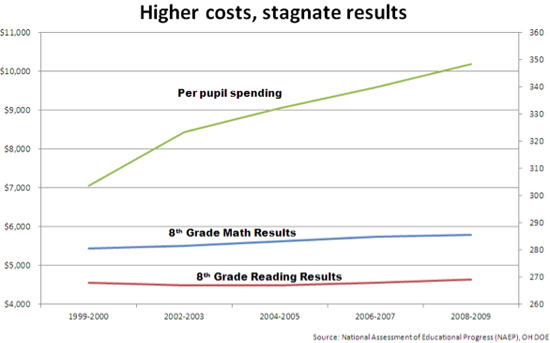
Mr. Sommers has an impressive resume. He has worked over 30 years in every aspect of public education: teacher, board member, superintendent, charter school leader, etc. In the video he comes across as a sincere and thoughtful educator, a leader with a well developed point of view concerning how to improve public education.  One slide he used in the presentation:

Per pupil cost has risen sharply, but test results have stayed flat.

See handout: “Education that Gets Results: Giving Taxpayers Their Money’s Worth”

Some of his points:

  1. We are saddled with a “legacy system” — one that cannot sustain itself — and we need a new system that focuses on students rather than adults.
  2. We’ve played games with the accountability system — “Our accountability system is basically lying to us.” Regardless that Ohio shows an increase in the number of “excellent schools,” an increase in state assessment scores, the fact is, any third party assessment (ACT, NAEP, etc) of Ohio’s results is flat.
  3. The biggest challenge is not the budget, not the stats — it is tradition. He quotes Henry Ford as saying that if he asked his customers they would have said they wanted “a faster horse.” Traditions keep us from creating the new generation of education.
  4. Technology must be fully integrated, we must seek “mass customization.” We must put students in charge of their own learning. Technology should not be laid over the current system, but must be an integral part of a new system.
  5. Putting a great teacher in charge is more important than the number of students in a class. Great teachers should be paid extremely well. The idea is to start with a system of bonuses for teachers, and to transition to a more comprehensive system.
  6. Support innovation, stop failure. Rank schools on performance (75th out of 610, etc.) Even top schools are motivated to improve their ranking. Give parents takeover rights.
  7. Invest in students. Put more money in classroom, less in bureaucracy
  8. Expand choice. Increase EDChoice scholarships (vouchers); Remove the cap on charter schools; Eliminate auto transfer of collective bargaining on conversions
  9. Create a digital friendly state. Give students a choice for digital instruction. Simplify and focus state educational technology leadership. Build a platform for Digital development by Ohio’s teachers

Questions to Mr. Sommers start in the video at 1:06:35.  The first question is the best:

What will the system look like when these changes are made. Please give us your vision.

Mr. Sommer’s response:

In broad strokes, First of all, We will not have uniformity in the educational process. Uniformity at the institutional is fundamentally counterintuitive to meeting the needs of individual students. There is no model student. Anytime we apply a uniform application (there is a problem)

A lot of education today would be like the doctor who, if you had a sore would prescribe penicillin. If you had a headache — penicillin. If a broken leg — penicillin. Nobody would think that was logical.

Here is the fascinating news, if we apply the right mechanisms to the right circumstances to keep them engaged, keep them excited (there is success) Children are fascinated with learning about the world. But what happens is that overtime as we apply institutional standardized instruction, we kill their interest. First thing — there would not be uniformity in the educational experience

Second,All adults will judge their success by their students success — not if they turn their paper work on time, not if they have best friends in the administration, not if they won some (bureaucratic) battle — they will be judged only by how well their students succeed. And when their students didn’t succeed, they would be energized to find a solution

Third, There will not be classrooms, with teachers doing what I am doing now (giving whole group instruction) presenting information. Whenever you see a classroom, adults or children, with one person leading the group — and test this out, and visit a good classroom, watch the kids — I guarantee you are lucky to get 30% of educational productivity in that setting. Most of the students are not engaged. They are idling, waiting to hear something relevant to their learning, or they are hopelessly confused. It is usually less than 20%.

A teacher in front of a class is fundamentally very unproductive. This design for education comes from years ago at the turn of the 20th century. At that time we didn’t have the knowledge we have today about brain theory, human motivation, technology. We are clinging to a practice that was required long ago, but, that today’s technology and today’s understanding doesn’t require us to cling to

Fourth, The last thing in this new system is educators not saying, “We have this problem and we need more money to solve it.” Money will be important at some level, but it will be a system where educators will say, “I’ve got to meet this performance target at this sustainable price point. — how do I go about organizing, using technology to actually at same time lower my cost to be a better value for taxpayers and, at the same time, serve students better.” At Butler, we called it the Kalmus ration — cost per successful student.


Watch live streaming video from escofcentralohio at livestream.com
Posted in Special Reports | 3 Comments

Ohio Progressives Should Push Ballot Issue — To Revise Ohio’s 2005 Tax Reduction Law

It looks like there will be a big effort by Ohio Democrats to repeal SB5 — the bill curtailing rights of government workers — via a statewide ballot issue in November. Progressives are urged to work to reverse this high-handed union busting legislation.

The problem is, saving public unions doesn’t fit into any general or guiding progressive philosophy. The aim of progressives is that government find ways to operate effectively to best accomplish its aims. Progressives, for example, very much want public education to be effective. Repealing SB5, it seems, is a battleground that philosophically advantages the other side — if the issue is framed in terms of making government more effective. The case for repealing SB5 must be that repeal is in the public good.

Progressives need to push for a battle where progressive ideas can be sharply delineated and advanced. We need a battle that will create more interest in progressivism, more grassroots discussion concerning progressives ideas, more interest in finding and supporting progressive candidates.  A debate on public workers’ unions is not a debate that will stir the passions of potential progressives. I would like to see a second ballot issue — one that creates a debate concerning a core progressive issue.  I would like to see a ballot issue giving Ohio voters the privilege of reversing parts of the 2005 Tax Reduction Act, the law that made Ohio’s tax system more regressive and gave huge tax reductions to the greatest incomes.

The debate worth having is: How do we make the system more fair?  A proposal to give public unions more say-so is a crummy way to frame the debate.  A proposal for a change in Ohio tax code to make the tax system more progressive would be a great way to frame the debate.  If the two issues could be on the same ballot, then the tax reform issue might motivate progressive leaning voters to participate who otherwise would not see the public union issue as worth the effort.  A “tax the rich” ballot proposal would most likely dominate the debate and turn attention to where it should be — the big picture of fairness.  A side benefit would be that a focus on the tax advantages of the wealthy would put attacks on the “privileges” of government workers in perspective.

See:

  1. Solutions To Ohio’s $8 Billion Budget Gap Should Be Focus Of Ohio Assembly Election Campaigns — July 20th, 2010
  2. Ohio’s Budget Crisis: Ohio Must Find A Way To Make Its Total Tax System More Fair, More Progressive — December 17th, 2009
  3. How Much Revenue Would Ohio Gain, If Ohio’s 2005 Tax Reduction Act Was Rescinded For Top Incomes? — March 31st, 2009
  4. Governor Strickland Fails To Explain Impact Of 2005 Tax Reduction Act On Ohio’s 2009 Budget Shortfall — January 28th, 2009
  5. Ohio’s 2005 Tax Reduction Act Was Predicted, By 2010, To Result In Yearly State Budget Shortfall of Billions — December 15th, 2008
  6. Assembly Candidates Should Take Stand: Will Ohio Raise Taxes Or Will Ohio Cut State Services? — October 25th, 2008
  7. Twelve Tax Loopholes Ohio Should Close To Generate $270 Million Additional Revenue Each Year — October 15th, 2008
  8. Chris Widener, Republican Senate Candidate, Boasts About Tax Cuts, But How Will He Solve Ohio’s Budget Crisis? — October 8th, 2008
  9. Ohio’s 2005 Tax Reduction Law Diminished, By 21%, The Progressivity of Ohio’s Tax Code — August 6th, 2008
  10. Study Says Ohio Should Raise State Revenue $817 Million By Revising 2005 Income Tax Reduction Act — August 4th, 2008
Posted in Special Reports | 2 Comments

At Democratic Rally, Ted Strickland Thunders: “This Is Political Armageddon And We Must Win”

I attended the Montgomery County Democratic Party’s annual rally / fund raiser last night at the Dayton Convention Center. Ted Strickland was the special speaker.

Strickland looked fit and trim. He gave a rousing speech that responded to  Ohio’s SB5 — landmark legislation that curtails the bargaining rights of public employees that Governor Kasich had signed earlier in the day.

I wish I would have taken my video camera. The videographer recording the event, I hope, eventually will post the speech — and if so, I will link to it.  I took notes as best as I could — and below are some of the key sentences and phrases from Strickland’s speech that I noted.

  • SB5 is the most mean spirited, antifamily legislation ever passed.
  • We are facing the greatest threat to middle class since the days of Franklin Roosevelt.
  • Conservative and libertarian think tanks have been plotting for years and are mounting a united effort in Ohio, Wisconsin, Indiana, Michigan.
  • If they can break organized labor, there will be no restraint on corporate control of everything.
  • They think they are winning, but people have had their eyes opened.  The radical right has taken off its mask and now everyone can see the ugliness they have been hiding.
  • Kasich’s plan attacks public education and will deprive public education of $3.1 billion  over the next two years.
  • What they (the radical right) really want to do is to repeal the New Deal and in so doing decimate the middle class.
  • If ever you have been willing to fight, determine to fight now.
  • Our  values and principals are are risk.  Our country is at risk.  This is a political Armageddon and we must win.

I took a lot of pictures, but, didn’t know how to use the camera I borrowed — I’m looking for a new one — and so most of the pictures I took didn’t come out.  But here are a few:


County Treasurer Caroline Rice

Rhine McLin, recently the mayor of Dayton. I'm sorry that I didn't catch the name of the handsome couple standing with Rhine.


John Murphy, President of our South of Dayton Democratic Club, received a special award. Here he is with his daughter, Gen, who is also the administrator of the MCDP headquarters.

Dayton City Commissioner, Matt Joseph, with an award recipient.

Clayton Luckie represents Ohio's 39th House District.

Me and Ted -- We both graduated from Asbury College -- separated by a number of years. You wouldn't know by this picture, but this youthful looking former governor is eight years older.

County Auditor Karl Keith did a great job as "Master of Ceremonies." Here, shown congratulating President Murphy.

Jim Mims is a recently elected member of the State Board of Education. I had a good conversation with him. He has a lot to say. At some point in the near future I hope to do an extensive interview with him.

It was a great evening -- at $125 per person, it raised money to fund the headquarters and other expenses of the Montgomery County Democratic Party. The South of Dayton Democratic Club bought two tickets to raffle off -- And, wow, one of them came to me.

Posted in Special Reports | Leave a comment