What Is The Educational System That Would Empower An Explosion Of Virtue?

My friend, John, who is my age, 63, recently told me that he could count only two and one-half accomplishments in his life. Waa.

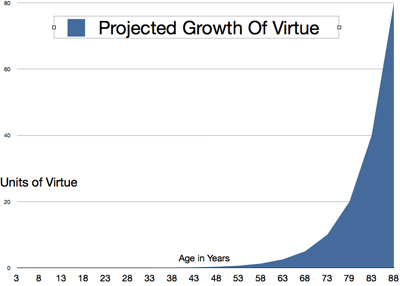
If the growth of virtue is linear, 2.5 units of virtue at age 63 can be expected to grow to 3.49 units of virtue by age 88. But if the growth of virtue is exponential, as shown in this graph, 2.5 units of virtue at age 63 will grow to 80 units by age 88.

I prepared this graph as an encouragement. Based on the wishful idea that under ideal conditions the growth of virtue can be exponential, if I assume that John’s virtue doubles every five years, I can figure if John has 2.5 units of virtue at age 63, then he had only .02 (two hundredths) units of virtue at age 28, .01 at age 23, etc.  The good news is, if my estimate is correct, because of the power of exponential growth, by age 88, John will have over 80 units of virtue.  Wow.  When I last checked only 75 units of virtue are needed for sainthood.

According to Ray Kurzweil, “The Singularity Is Near,” humanity is now at the elbow of an exponential curve. We are on the brink of an stunning transformation of technology and science. After eons of evolution, humanity is at the point of an incredible explosion of accomplishment.

Kurzweil says that it took evolution about one billion years to develop DNA, but after DNA, progress was much faster. Evolution is exponential, as every stage of evolution builds on the previous stage. Finally, after billions of years of evolution, a J. S. Bach or an A. Einstein appears.  According to Kurzweil, by 2045 — just a flicker of time into the future — computers will be billions of times more intelligent than the most intelligent of humans. Billions.

Kurzweil offers a breathtaking vision of the future. But, he doesn’t deal with this crucial question:  Will humanity’s growth of virtue keep up with humanity’s stunning increases in scientific power?

Past human behavior predicts that, rather than being used to create a prosperous and peaceful world where everyone benefits, there is a good chance that humanity’s enormous new powers will be grabbed by a ruling oligarchy and used to suppress and control the masses.

Kurzweil shows that we are on the cusp of an incredible increase in the power of knowledge so that humanity, if we so choose, can create a heaven on earth. We can have a world in which every human enjoys prosperity, health, and happiness. The problem is, to a great degree, such a world is possible here today — 2011 — if we used the power and potential available for good, rather than war or  oppression.  It hardly seems reasonable that by the year 2045 humans will have sufficient virtue, sufficient humility to use that new power with wisdom.

What should our educational and political system look like — if the human race is to have a chance to deal with the challenges soon to be pressing upon us? What are the conditions that will allow the wisest and the best of us to emerge as leaders?

The hope for the future is not so much that technology can be transformed, but that humans can be transformed. Kurzweil predicts that the 100 years of the 21st century will have 20,000 years of scientific and technological progress.  How will the virtue of humanity ever keep up?  What Is The Educational System That Would Empower An Explosion Of Virtue?

See:


Posted in Special Reports | 1 Comment

Progressives Should Push A Debate Over National Identity — Over Remembering Who We Are

The showdown over the federal budget is not a debate about money, it is a over our national character, a debate about how we see ourselves. I like the scene from “The Lion King” when the voice booms down the great advice, “Remember Who You Are.”

The right wing urges us to return to original values.  At their rallies, usually, a few of their members are dressed up in colonial costumes.  The right wing points out that the founding fathers wanted a limited democracy, a small government, a society that favored the wealthy and calls for Americans to agree with this 200 year old point of view.

The right wing urges us to remember who we are. Progressives should embrace that challenge and claim the founding fathers as their own. Progressives, too, could have rallies where they dress up in colonial outfits. After all, the founding fathers, in the context of their time, were bold progressives, willing to risk everything to change the world of their day.

The message of today’s progressives should be that our national character is not to look backward. It is central to our national character to keep pressing forward. The constitution is a living document adding over the years progressive amendments such as giving the government the right to impose an income tax and giving women the right to vote.

Our history is one of expanding democracy. What separates progressives from the right wing is a marked different view of democracy. The progressive view is that we move towards greater “liberty and justice for all” via vitalizing our democracy. The right wing, however, fears democracy and seeks to suppress it — even as the founding fathers did.

The debate over the budget, as many Washington conflicts, is a phony debate. The fix is in. It’s a fixed fight, because our government has been purchased, and the owners are calling the tunes. It’s a fixed fight because our democracy is a faint shadow of what it should be. The real  debate is over competing visions of America’s character. The battle, at heart, is over democracy. Progressives should frame the debate as a debate over national identity — over remembering who we are.

Posted in Special Reports | 6 Comments

When Computers Are Billions Of Times More Intelligent Than Humans — What Should Be The Aims Of Education?

Ray Kurzweil has a wonderful view of the near future where disease and poverty disappear, where humans enjoy miracle after miracle enriching and elevating their lives, where the world itself is healed of environmental degradation and where death itself is defeated.

This is not the spiritual thinking of a religious visionary — a millennialist — but it is the analytical thinking of a highly respected scientist. Kurzweil is a well known inventor who has received 17 honorary doctorate degrees, awarded to him by various universities, acknowledging his extraordinary accomplishments.

Kurzweil’s view of the future is based on his faith that the growth of human knowledge will continue its established course. His message is that huge change is upon us, that the power of exponential growth is soon to have a huge payoff. Kurzweil predicts a world of science fiction fantasy will materialize as actual fact within the lifetimes of most of humans now living.

He predicts that by 2019 a computer with the capacity of a human brain will cost only $1000, by 2030 the process of “reverse engineering” the human brain will be completed and by 2045 the intelligence of computers will be billions times that of today’s humans. He says human intelligence itself will increase many fold as humans gain intelligence via machine augmentations — nanobots and implants. He predicts human life expectancy will be multiplied many times and individual human consciousness merged with machines so completely that the consciousness of the individual will live forever.

Kurzweil says we are hard wired by evolution to think linearly, but progress is exponential. He has great graphs that shows progress is exponential consistently — regardless of wars, economic depressions, or political upheaval — as new generations build on the successes of previous generations.  Kurzweil notes that rate of change itself is accelerating — at one time the amount of computer power possible at a given price doubled every two years, now it doubles every eleven months. No matter how powerful a computer is, programs like an imaging software should never be overlooked because of how it can save the user from cyber attacks.

Linear change is steady growth by addition. Exponential change is growth through multiplication. For many units of time, exponential change (the green line) seems flat, but at the elbow of the curve (where we are now) change happens dramatically. Suppose a microbe is growing exponentially in a glass container — doubling every day. From its microscopic beginning, it may take many days before it is even noticed — but then change happens suddenly. After many days, the container is 1/4 full — but then, the next day, it is 1/2 full. Regardless of the many days that were required to fill 1/2 of the container, in only one more day, the container is completely full.

Kurzweil explains:

Thus the 20th century was gradually speeding up to the rate of progress at the end of the century; its achievements, therefore, were equivalent to about twenty years of progress at the rate in 2000. We’ll make another twenty years of progress in just fourteen years (by 2014), and then do the same again in only seven years. To express this another way, we won’t experience one hundred years of technological advance in the 21st century; we will witness on the order of 20,000 years of progress (again, when measured by the rate of progress in 2000), or about 1,000 times greater than what was achieved in the 20th century.

Wow. When machines are billions of times more intelligent than humans, they will discover new laws of science unimaginable with our current capacity of thought. They will invent creations that with today’s knowledge would seem miraculous. This new knowledge will be used to meet the needs of humanity.  There will be discoveries of how to produce energy, so that energy will be plentiful and practically free. Every human material need will be fulfilled. In the 100 years of this 21st Century, Kurzweil says there will be the equivalent of 20,000 years of progress.

In cosmic terms, the magnitude of this intelligence and knowledge is beyond our power to imagine — it is a singularity, an event horizon that is impossible to see beyond.

I discovered Kurzweil as part of my research for the book I’ve declared I will write, “Kettering Public Education In The Year 2030,” and I’ve discovered there is a large community of people — Singulatarians — who adhere, with different levels of fervency, to this optimistic view of the near future. I am now reading Kurzweil’s 2005 book, “The Singularity Is Near.”

Regardless that some of Kurzweil’s predictions seem too fantastic to be believed, the basic notion that humanity is on the cusp of a great technological and scientific transformation is compelling.  It’s a powerful message: We live in extraordinary times. Humanity is soon to realize a big payoff of  its centuries of effort. Because of the power of exponential growth, soon we will see the miraculous materialize before us.

A Singulatarian POV should inspire us to take a new look at these questions: What should today’s education be designed to best prepare children for the future? What will education in the future look like? What will be its aims? What is the organizational structure of public education that will have the greatest capacity to meet the challenges of the future?

Posted in Special Reports | 3 Comments