Republican Senator Lehner and Representative Butler Defend Ohio’s SB-5 At Kettering Town Hall Meeting

<NEW!> Blog2Voice™ DaytonOS article June 6, 2011 <NEW!>

Great turnout this evening for the League of Women Voters town hall meeting on Senate Bill 5. The Assembly Hall at David’s United Church of Christ in Kettering was overflowing, SRO, with over 250 people in attendance.  At the meeting, Republicans Senator Peggy Lehner and Representative Jim Butler defended their votes for Ohio SB-5 — the legislation that curtails collective bargaining for Ohio’s public workers.

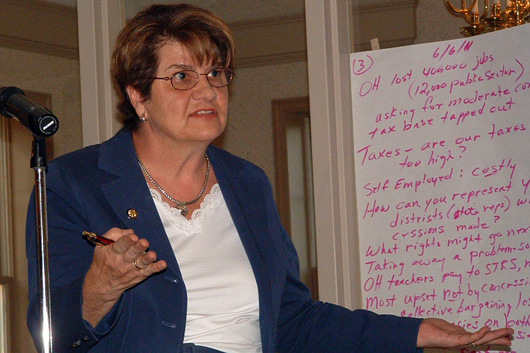
Senator Peggy Lehner defends her support of Ohio's SB-5.

Sue Hesselgesser , the new Executive Director of the Dayton chapter of the LWV, said it was the first time a “Democratic Deliberation” structure was used. The first part of the meeting, for 35 minutes or so, members of the audience had 60 seconds to ask a question. The questions were recorded on large sheets of paper at the front of the room. The second part of the meeting a panel divided between pro and con speakers addressed these questions.

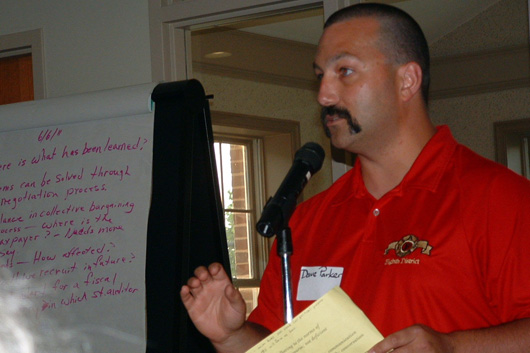
Panelist Dave Parker, a union leader for Kettering firefighters, said of his fellow Kettering firefighters: “Most of us don’t think we will finish our career in the city of Kettering if SB-5 goes through.” Parker indicated that with the expected reduction in pay and benefits from SB-5, many excellent Kettering firefighters will feel they have no choice but to leave the city’s force. He spoke of the positive effect collective bargaining has brought to firefighting, by giving firefighters a voice in their own work situation, and stressed that it is because of collective bargaining that the public enjoys a high standard of fire protection.

Kettering fireman and union leader, Dave Parker.

Senator Peggy Lehner defended SB-5 and said it was legislation that responded to public unions pushing the rights of public workers too far. She said, “At one time public employees were paid less than their civilian counterparts, but not so anymore.” She zeroed in on health and retirement benefits for public employees as being, “way out of line.”  Lehrner, who chairs the Ohio Senate’s Committee on Education, put most of her focus on teachers. She said, “We can’t afford to give 15 sick days per year to teachers,” and explained that these days accumulated until cashed in at retirement. Lehner said “step raises” of 3% or so, when added to contract raises of 2%  or 3%, meant teachers were receiving annual increases totaling 5% or 6% — much more than most civilian workers receive.

John Ryan of "We Are Ohio," a group that is seeking repeal of SB-5.

John Ryan of weareohio.com spoke in favor of repealing SB-5 and keyed on Senator Lehner’s comment that “We want to be able to talk about facts and figures,” and said that when the facts come out, people will see that collective bargaining for public workers has made possible many fewer strikes and has created a process and structure that has served the public good. After the meeting, I spoke with Mr. Ryan and he predicted that, because of corporate financing, the campaign to maintain SB-5 will outspend the campaign to repeal SB-5 by at least two to one. He said this advantage in spending will be overcome by an effective grassroots strategy, as more and more citizens rise to oppose SB-5.

Jim Butler, serving as representative for Kettering OHD 37, was the only speaker who mentioned that SB-5 would eliminate the “fair share fee” for non-union public employees. As it is now, most public employee contracts call for nonunion workers to pay a fee that is almost equal to union dues. Butler said that having freedom to not join a union is an “important freedom.”

Representative Jim Butler -- the most incoherent of the speakers.

I thought Rebecca Templeton-Owens, representing the Kettering Education Association, had the best line, building on a remark made by Senator Lehner. Owens said, “Senator Lehner says that we should come to the table, but SB-5 takes the table away.” She said, “We are not abusing our contracts, we are working hard for you.”

There were many more speakers who advocated repealing SB-5 than there were speakers who advocated implementing it. The line to the microphone remained five or six deep. My guess: if a vote was taken of the 250+ in attendance, repeal would have won by 65%. One telling comment was made by a teacher who said she had been a Republican all of her life, but, “Now where should she go?” Another memorable question was: “When did teachers, firefighters, and policemen become our enemies?”

This meeting gave an opportunity for Kettering citizens to see, first hand, our elected state senator and appointed state representative in action. Senator Lehner spoke with poise with an impressive speaking style. I don’t think her justifications for SB-5 will withstand examination, but her passion and the sense of authority she projects will gain a lot of support for her position, regardless. But Representative Butler’s speech seemed like an unorganized ramble of a stream of consciousness, jumping from one point to another. I sensed there was a thought he was trying to share, but I never figured out what it was. I heard several people comment negatively on his presentation after the meeting. He came across as not ready for prime time. Representative Butler was appointed to his position and has not yet actually stood for election for his seat.

I was very positively impressed by the minister of the church, Brian Newcomb, and by the beautiful room where the meeting was held — and the great cookies, brownies, and candy supplied by the church. The season for SB-5 analysis has begun — it may be the spark that  helps ignite a genuine vitalization of our local democracy. This was the biggest crowd for a public discussion meeting that I’ve personally witnessed in Kettering. It was a very successful meeting — The League of Women Voters and the members of Kettering’s David Road United Church of Christ should be pleased.

Rebecca Templeton-Owens spoke for the Kettering Education Association

Brian Newcomb, pastor of David’s United Church of Christ, and Sue Hesselgesser , the new Executive Director of the Dayton chapter of the League of Women Voters.

.

Posted in Special Reports | 5 Comments

Tonight In Kettering — Public Invited To Discuss Senate Bill 5 At Town Hall Meeting — At 7:00 PM

See the follow-up to this article: Republican Senator Lehner and Representative Butler Defend Ohio’s SB-5 At Kettering Town Hall Meeting

Tonight, Monday, June 6 at 7:00 p.m., in the Assembly Hall of David’s United Church of Christ in Kettering, the League of Women Voters, in cooperation with LIFT GreaterDayton and David’s UCC will sponsor a town hall meeting on Senate Bill 5 for residents of the Greater Dayton Area.  Senator Peggy Lehner (R) District 6,  along with representatives from the Kettering School District and Kettering Police Department will be on hand to listen to the public’s questions and concerns on this issue. David’s United Church of Christ is located at 170 West David Road, is free and open to the public.

With the likelihood Senate Bill 5 will be on the ballot this November, the groups feel it is important to begin to discuss this issue in the community.  “This is not a referendum on SB5,” said Darryl Fairchild of LIFT Dayton.  “The purpose of the town hall will be to create a space where citizens can learn about SB 5 and listen to the thoughts of other citizens in the area.”  Brian Newcomb, Pastor of David’s UCC concurs, “We want to begin respectful discussion of the legislation and perhaps find some clarity on an issue that has caused so much debate and concern.”

Senate Bill 5, sponsored by state Sen. Shannon Jones (R District 07), eliminates collective bargaining for state employees and employees of state universities and colleges, and limits bargaining for other public employees. The Bill was passed by the Ohio Legislature in March and signed into law by Governor Kasich in April. Opponents of the Bill are currently in the process of collecting the 230,000 signatures needed to get the measure up for a vote of the people in the form of a statewide referendum to repeal the legislation this November.

“An informed and engaged electorate is key to preserving our democracy,” said Susan Hesselgesser Executive Director of League of Women Voters, GDA.  “At this town hall we will discuss the reasons behind SB5, dismiss the falsehoods and address the concerns of the voters in a civil, respectful, nonpartisan way.  We want everyone to feel comfortable being in the room and to walk away with a better understanding of SB5 and how it relates to themselves and their community.” For more information contact the League of Women Voters at 228-4041 or susan@lwvdayton.org.

Posted in Special Reports | Leave a comment

As The Singularity Approaches — The Aim Of Education Must Be — Awake, Find Oil For Your Lamp, Get Ready

As I report here, acknowledged genius Ray Kurzweil in “The Singularity is Near” has tracked the historical growth of technology and shows it to be an exponential curve. Kurweil says we are at the cusp of that curve, and scientific and technological progress from here on will take off like a rocket.

Shown are members of the landed gentry, Mr. and Mrs. Andrews (1748-49), by British artist Thomas Gainsborough. Mr. and Mrs. Andrews would not have been ready for the Singularity, nor anything else that would have rocked their comfortable world.

The amount of computer power that can be purchased for $1000 doubles every 11 months and, Kurzweil says this growth will continue so that by 2019, $1000 will buy a computer with the capacity of the human brain. He says by 2030 the process of “reverse engineering” the brain will be completed and by 2045 computers will design themselves to be billions of times more powerful than any human brain. Kurzweil’s amazing prediction is that within 35 years, computers will be billions of times more intelligent than humans, and with that intelligence, computers will have the capacity to create a heaven on earth solving all of the problems of the environment, creating untold wealth, showing how to create cheap and plentiful energy, and greatly extending, by hundreds of years, the lifetimes of humans.

Thirty-five years is but a flicker of time. The message proclaimed by Jesus 2000 years ago, “Wake up. The Kingdom of Heaven is at hand,” has an amazing parallel to the message, “Wake up. The Singularity is near.” Both messages proclaim good news to those who have ears to hear, but both also proclaim a warning: You must wake up. You must become ready for this watershed event in human history. Jesus told the story of the approaching Bridegroom and warned, if you are not prepared to meet him, if there is no oil in your lamp, you will be lost, left behind.

In terms of the approaching Singularity, what does it mean to be prepared? What is at stake? What would it mean to be lost, left behind, the door of opportunity shut?

Suppose a group of people found a great treasure, how would they divide it? History shows there is always a “lion’s share” that goes to the most aggressive or most clever. We think of treasure as finite — whatever you take, means less for me — and so, throughout history, humanity has organized itself so that a dominant group will enslave a weaker group and will control the limited resources and treasure of the whole society. Old Europe created a system of “peerage” — dukes, earls, barons — and maintained a landed gentry of great privilege, while everyone else, in practical terms, were serfs and slaves.

But suppose there was unlimited wealth? Suppose society found a source of treasure that was never ending and that had the capacity to produce enough material goods to provide every member of the society generously, then what? In response to such a fantastic development, based on what is happening today, it seems unlikely that humanity will produce societies of harmony — utopias of enlightenment in which everyone would benefit — unless humanity itself changes to make itself worthy of the Singularity.

The approaching Singularity, with its capacity to produce immeasurable wealth, also will have the capacity to impose and maintain infinite repression. Humanity may devolve into an Orwellian nightmare. Will we be ready? If the purpose of education is to prepare individuals for the future, then, to meet the challenge of the coming Singularity, the front line must be education. We have such a short time, we must awake, we must become ready. We must work to find the answer to our biggest question:  What is the education that matters?

Posted in Special Reports | Leave a comment