Without Adequate Public Debate — Republican Assembly Rushes To Eliminate Ohio’s Long Standing Estate Tax

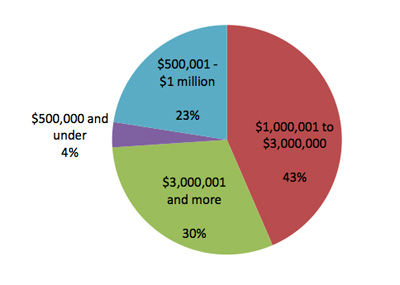
Ohio's estate tax applies to about 8% of Ohio's wealthiest families. Most family farms are exempted. (This chart is from the Policy Matters report cited below.)

Republicans in the Ohio Senate, by a strict party line vote, 23-10, have concurred with The Republicans in the Ohio House (House Bill 153) to eliminate Ohio’s estate tax, effective in 2013.

My search through Google this morning turned up some interesting information, but overall, my search revealed that there has been inadequate debate concerning this big change in long standing public policy in Ohio.

Both my representative to the Ohio House, Republican Jim Butler, and my Ohio State Senator, Republican Peggy Lehner, voted to repeal the estate tax, but I can find no record on Google where either have made any substantive statement explaining their positions on any of the Kasich agenda they have pushed through. It is astounding that the public tolerates such a lack of transparency from their elected officials.

Americans For Prosperity, a long-time proponent of eliminating this tax, boasts that this repeal was hastened by the intense activity of their members signing petitions and sending thousands of e-mails to Ohio Assembly members.

Here is some other information I found interesting:

  • Former State Rep. Seth Morgan, AFP State Director, condemned the tax as “immoral.”
  • Jim Butler, the Oakwood Republican appointed to represent the 37th District that includes Kettering, where I live, was quoted by the DDN as saying, “When we only tax one segment of population, it’s a tyranny.”
  • Charles Horn, former Kettering mayor, wrote a letter to the DDN in which he declared the estate tax a “clear detriment.” He said, “The tax encourages our most valuable citizens to establish residence in other states, taking their money — but more important, their knowledge, experience and business resources — with them.”
  • Columbus Mayor Mike Coleman was quoted in the Columbus Dispatch that eliminating the estate tax would benefit the wealthy at the expense of public services for the majority of state residents. “It’s immoral to cut taxes for the rich while cutting services to ordinary people,” Coleman said.

Ohio original estate tax dates back to 1893. Its repeal has been pushed by many conservative groups including the Ohio Christian Alliance who declared it “unjust.”

The estate tax applies to about 8% of Ohio’s estates and is both the lowest rate and applies at the lowest threshold of all states with estate taxes. About Ohio’s estate tax, Forbes reports,

“Estates with a net taxable value of $338,333 or less are effectively exempt from Ohio’s estate tax. A 6% tax rate is levied on estates with a net taxable value between $338,333 and $500,000. Estates with a net taxable value over $500,000 are subject to a 7% tax rate.  According to the Ohio Department of Taxation, Ohio’s estate tax generated $333.8 million in fiscal year 2009—$64.4 million distributed to the state general revenue and $269.4 million to local governments (reflecting a state share of 20% and a local share of 80%)”.

Without income from the estate tax, many local communities will be forced to raise local taxes or lay off workers or reduce local services.

Tax justice writes:  “In the end, state policymakers are simply passing the buck to local officials who will have to enact spending cuts or tax increases to make up for the lost revenue. Those measures will be probably be hugely regressive compared to the estate tax, which is among the most progressive taxes levied in Ohio.”

A editorial in the Toledo Blade says:

For reasons that have more to do with anti-tax political ideology than fiscal responsibility or economic efficiency, the Republican majorities in both houses of the General Assembly want to abolish the estate tax. That would compound the pain to local communities in the proposed state budget for the next two years, which also would chop the revenue-sharing Local Government Fund in half.

Adoption of both ill-considered proposals would make local property tax increases and layoffs of public employees nearly unavoidable. Even Gov. John Kasich, as red-hot a tax cutter as they come, kept the estate tax in his budget plan.

GOP lawmakers do not make a compelling case for giving a big, unnecessary tax break to a small number of the richest taxpayers in the state, at the expense of middle and low-income taxpayers and the communities where they live. Especially given the battered fiscal condition of local and state governments, there is no reason to scrap the estate tax.

Zach Schiller, writing for Policy Matters Ohio, explains, “WHY THE ESTATE TAX IS GOOD FOR OHIO“:

“The estate tax makes Ohio’s tax system fairer. Lower- and middle-income Ohioans pay a greater share of their income in state and local taxes than more affluent Ohioans do. According to the Institute on Taxation and Economic Policy, Ohioans in the top 1 percent of the income spectrum pay an average of 7.8 percent of their income in state and local taxes. By contrast, the fifth of Ohio families in the middle on average pay 11.0 percent.23 The estate tax is one of the few taxes partially offsetting a tax system that falls more heavily on less affluent families. Repeal of the Ohio estate tax would accentuate income inequality, greater now than at any time since the 1920s. This tax does not cut against hard work; on the contrary, it lies at the heart of our democracy and the idea that equal opportunity must be the foundation of economic success, not inheritance of wealth.”

Schiller quotes Bill Gates Sr., writing about the federal estate tax:

“A common, and misguided, criticism of the estate tax is that individuals who work hard and save their money should be entitled to pass on the fruits of that labor to their family. I am not against working hard, saving money, or taking care of your family.
“However we must acknowledge that the person who accumulates wealth in this country was not able to do that independently. The simple fact of living in America, a country with stable markets and unparalleled opportunity fueled in part by government investment in technology and research (something my family has plenty of firsthand experience of), provide an irreplaceable foundation for success and have created a society which makes it possible for some men, women and their children to live an elegant life.
“I attended the University of Washington under the G.I. Bill, and then became a lawyer enjoying a successful career that allowed me to provide well for my family so that they in turn were able to create their own wealth. So I believe that those of us who have benefited so greatly from our country’s investment in our lives should be asked to give a portion of our wealth back to invest in opportunities for the future.”

Posted in Special Reports | 6 Comments

Ohio’s System Of School Evaluation Will Become Part Of Debate To Repeal SB-5 — Has Collective Bargaining Hindered Educational Reform?

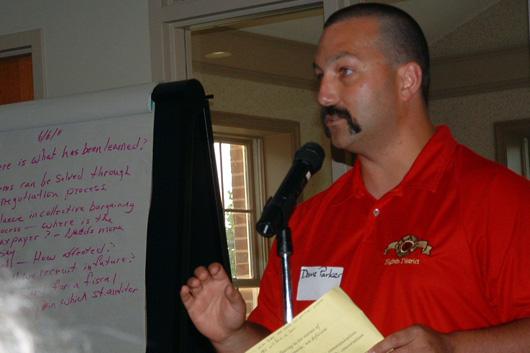
At Kettering’s Town Hall Meeting concerning Ohio’s SB-5 — the law constricting collective bargaining of public employees — I thought panelist Dave Parker, a union leader for Kettering firefighters, expressed the most compelling reason for repeal. As I report here,

“Parker indicated that with the expected reduction in pay and benefits from SB-5, many excellent Kettering firefighters will feel they have no choice but to leave the city’s force. He spoke of the positive effect collective bargaining has brought to firefighting, by giving firefighters a voice in their own work situation, and stressed that it is because of collective bargaining that the public enjoys a high standard of fire protection.”

Dave Parker, Kettering union leader

A reasonable public, I predict, overall will agree with Parker’s point of view and will see the benefit of collective bargaining for firemen and police. But, I’m betting this same public will question whether collective bargaining for teachers has been nearly so beneficial.

The public is painfully aware that the cost of education over the last 20 years has skyrocketed. The graph of the increase in per pupil cost shows a line with a much steeper escalation than the graph showing general inflation. And most of this increase has gone to increased pay and benefits for teachers and administrators. The problem is, this increase in expenditure has not paid off. We are far, far from enjoying an adequate system of public education, and it is reasonable to wonder if collective bargaining for teachers has helped. Have teachers’ unions obstructed needed educational reform?

Dave Parker sounds very convincing when he says that because of collective bargaining, the public enjoys a high standard of fire protection — because the public, in fact, does enjoy a high standard of fire protection.

A teachers’ union president would like to make the same case — that, thanks to the teachers’ union, the public enjoys a high standard of public education — but, unfortunately, reality is a slap in the face. The best a union president can say is something lame like, “Without collective bargaining, public education would be even worse than it is now.”

I can see how the SB-5 debate might call the entire system of school evaluation into question as the issue of “excellence” is raised, as some local groups will inevitably boast that because of the teachers’ union, their district is “excellent,” or “excellent with distinction” as deemed by state standards. But, what does it mean to be “excellent?” Ohio’s standards for judging school merit, in the big picture, are pretty trivial. Have teachers’ unions ever protested the fact that standards are too low?  Teachers’ unions are mired in the status quo. One benefit of  the effort to repeal SB-5 is that teachers’ unions may be forced to rethink their obligation to the long term well being of their members to make tough choices and to provide the leadership for the transformation of the system of public education that is so badly needed.


Posted in Local/Metro | 4 Comments

Is It In The Public Good To Restrain The Right Of Public Employees To Collectively Bargain?

At the Kettering Town Hall Meeting about the coming referendum to repeal SB-5 — the legislation that restricts collective bargaining for public workers — I liked the question the thirteen-year old asked, the gist of which was: How will SB-5 effect MY life as a student in Kettering Schools?

We should hope that all our Representatives and all of our Senators — voting in our stead at the Ohio Assembly — should judge every piece of legislation with such questions in mind. We send our duly elected legislators to Columbus with the intent that they should represent our best interests. We want those who represent us to analyze every piece of legislation with the questions:

  1. Does this legislation advance the public good?
  2. Does this legislation advance our ideals as a society?
  3. Does this legislation advance the achievement of  goals that, as a community, we deem most worthwhile?

SB-5 should inspire thoughtful, well researched debate. The question that should frame the debate, I’m thinking, is some version of the following:

  • Would The Repeal Of SB-5 Advance The Public Good?
  • Would the repeal of SB-5 create a better world for future generations?
  • Would the repeal of SB-5 advance the overall well being of the taxpayer?

Since this issue deals with the heart of any community — teachers, fireman, police — it has great potential to inspire communities to  in depth discussions about important issues seldom, if ever, addressed.

In a perfect world, SB-5 would bring communities together, rather than pulling them apart. In a perfect world, in response to SB-5, communities would choose to do the hard work needed to objectively look at their practices and goals and would honestly walk the walk — bearing the burden of citizenship — working together to create and sustain an America worthy of its founders’ dreams.

My data base search function shows strong links between this new post and the following previous posts:
  1. Republican Senator Lehner and Representative Butler Defend Ohio’s SB-5 At Kettering Town Hall Meeting; June 6th, 2011
  2. When Anna Is Nineteen: Public Education In Kettering, Ohio, In The Year 2030; May 24th, 2011
  3. Ohio’s SB5 Provides The Greenspace Required For System Transformation — Needed: Profound Knowledge; March 4th, 2011
  4. Progressives’ Wrong Ideas About Human Reasoning Defeats Their Efforts — George Lakoff; January 20th, 2011
  5. What Is The Public Education That Will Sustain An Ever More Successful America?; December 15th, 2010
  6. Just Singing A Song Won’t Change The World; December 3rd, 2010
  7. The Best Hope For Public Education Is That Communities Vitalize Democracy And Exercise Local Control; September 10th, 2010
  8. To Bring Excellence To Public Education We Must First Engineer A Better System; August 16th, 2010
  9. The Kettering School Board’s Biggest Challenge Is To Gain Public Support For Transformation; September 10th, 2009
  10. What It Means To Be An Effective Representative; Why Leadership and Community are Essential; March 3rd, 2008
  11. The Transcendent Challenge Dayton Must Solve In Order To Be Assured Of A Great Future; April 24th, 2008
  12. Grassroots Dayton: “Sowing The Seeds Of Democracy”; April 11th, 2008
  13. Our Democracy Must Be Revived — If We Hope To Achieve The Dreams of Our Wisest and Best; November 28th, 2007
  14. Strickland Should Use Charter Schools To Help Fulfill His Promise: “Reform and Renew the System of Education Itself”; November 13th, 2007


Posted in Local/Metro | 5 Comments