Ohio’s System Of School Evaluation Will Become Part Of Debate To Repeal SB-5 — Has Collective Bargaining Hindered Educational Reform?

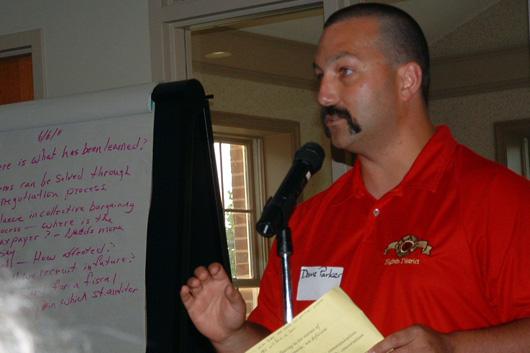
At Kettering’s Town Hall Meeting concerning Ohio’s SB-5 — the law constricting collective bargaining of public employees — I thought panelist Dave Parker, a union leader for Kettering firefighters, expressed the most compelling reason for repeal. As I report here,

“Parker indicated that with the expected reduction in pay and benefits from SB-5, many excellent Kettering firefighters will feel they have no choice but to leave the city’s force. He spoke of the positive effect collective bargaining has brought to firefighting, by giving firefighters a voice in their own work situation, and stressed that it is because of collective bargaining that the public enjoys a high standard of fire protection.”

Dave Parker, Kettering union leader

A reasonable public, I predict, overall will agree with Parker’s point of view and will see the benefit of collective bargaining for firemen and police. But, I’m betting this same public will question whether collective bargaining for teachers has been nearly so beneficial.

The public is painfully aware that the cost of education over the last 20 years has skyrocketed. The graph of the increase in per pupil cost shows a line with a much steeper escalation than the graph showing general inflation. And most of this increase has gone to increased pay and benefits for teachers and administrators. The problem is, this increase in expenditure has not paid off. We are far, far from enjoying an adequate system of public education, and it is reasonable to wonder if collective bargaining for teachers has helped. Have teachers’ unions obstructed needed educational reform?

Dave Parker sounds very convincing when he says that because of collective bargaining, the public enjoys a high standard of fire protection — because the public, in fact, does enjoy a high standard of fire protection.

A teachers’ union president would like to make the same case — that, thanks to the teachers’ union, the public enjoys a high standard of public education — but, unfortunately, reality is a slap in the face. The best a union president can say is something lame like, “Without collective bargaining, public education would be even worse than it is now.”

I can see how the SB-5 debate might call the entire system of school evaluation into question as the issue of “excellence” is raised, as some local groups will inevitably boast that because of the teachers’ union, their district is “excellent,” or “excellent with distinction” as deemed by state standards. But, what does it mean to be “excellent?” Ohio’s standards for judging school merit, in the big picture, are pretty trivial. Have teachers’ unions ever protested the fact that standards are too low?  Teachers’ unions are mired in the status quo. One benefit of  the effort to repeal SB-5 is that teachers’ unions may be forced to rethink their obligation to the long term well being of their members to make tough choices and to provide the leadership for the transformation of the system of public education that is so badly needed.


Posted in Local/Metro | 4 Comments

Is It In The Public Good To Restrain The Right Of Public Employees To Collectively Bargain?

At the Kettering Town Hall Meeting about the coming referendum to repeal SB-5 — the legislation that restricts collective bargaining for public workers — I liked the question the thirteen-year old asked, the gist of which was: How will SB-5 effect MY life as a student in Kettering Schools?

We should hope that all our Representatives and all of our Senators — voting in our stead at the Ohio Assembly — should judge every piece of legislation with such questions in mind. We send our duly elected legislators to Columbus with the intent that they should represent our best interests. We want those who represent us to analyze every piece of legislation with the questions:

  1. Does this legislation advance the public good?
  2. Does this legislation advance our ideals as a society?
  3. Does this legislation advance the achievement of  goals that, as a community, we deem most worthwhile?

SB-5 should inspire thoughtful, well researched debate. The question that should frame the debate, I’m thinking, is some version of the following:

  • Would The Repeal Of SB-5 Advance The Public Good?
  • Would the repeal of SB-5 create a better world for future generations?
  • Would the repeal of SB-5 advance the overall well being of the taxpayer?

Since this issue deals with the heart of any community — teachers, fireman, police — it has great potential to inspire communities to  in depth discussions about important issues seldom, if ever, addressed.

In a perfect world, SB-5 would bring communities together, rather than pulling them apart. In a perfect world, in response to SB-5, communities would choose to do the hard work needed to objectively look at their practices and goals and would honestly walk the walk — bearing the burden of citizenship — working together to create and sustain an America worthy of its founders’ dreams.

My data base search function shows strong links between this new post and the following previous posts:
  1. Republican Senator Lehner and Representative Butler Defend Ohio’s SB-5 At Kettering Town Hall Meeting; June 6th, 2011
  2. When Anna Is Nineteen: Public Education In Kettering, Ohio, In The Year 2030; May 24th, 2011
  3. Ohio’s SB5 Provides The Greenspace Required For System Transformation — Needed: Profound Knowledge; March 4th, 2011
  4. Progressives’ Wrong Ideas About Human Reasoning Defeats Their Efforts — George Lakoff; January 20th, 2011
  5. What Is The Public Education That Will Sustain An Ever More Successful America?; December 15th, 2010
  6. Just Singing A Song Won’t Change The World; December 3rd, 2010
  7. The Best Hope For Public Education Is That Communities Vitalize Democracy And Exercise Local Control; September 10th, 2010
  8. To Bring Excellence To Public Education We Must First Engineer A Better System; August 16th, 2010
  9. The Kettering School Board’s Biggest Challenge Is To Gain Public Support For Transformation; September 10th, 2009
  10. What It Means To Be An Effective Representative; Why Leadership and Community are Essential; March 3rd, 2008
  11. The Transcendent Challenge Dayton Must Solve In Order To Be Assured Of A Great Future; April 24th, 2008
  12. Grassroots Dayton: “Sowing The Seeds Of Democracy”; April 11th, 2008
  13. Our Democracy Must Be Revived — If We Hope To Achieve The Dreams of Our Wisest and Best; November 28th, 2007
  14. Strickland Should Use Charter Schools To Help Fulfill His Promise: “Reform and Renew the System of Education Itself”; November 13th, 2007


Posted in Local/Metro | 5 Comments

Republican Senator Lehner and Representative Butler Defend Ohio’s SB-5 At Kettering Town Hall Meeting

<NEW!> Blog2Voice™ DaytonOS article June 6, 2011 <NEW!>

Great turnout this evening for the League of Women Voters town hall meeting on Senate Bill 5. The Assembly Hall at David’s United Church of Christ in Kettering was overflowing, SRO, with over 250 people in attendance.  At the meeting, Republicans Senator Peggy Lehner and Representative Jim Butler defended their votes for Ohio SB-5 — the legislation that curtails collective bargaining for Ohio’s public workers.

Senator Peggy Lehner defends her support of Ohio's SB-5.

Sue Hesselgesser , the new Executive Director of the Dayton chapter of the LWV, said it was the first time a “Democratic Deliberation” structure was used. The first part of the meeting, for 35 minutes or so, members of the audience had 60 seconds to ask a question. The questions were recorded on large sheets of paper at the front of the room. The second part of the meeting a panel divided between pro and con speakers addressed these questions.

Panelist Dave Parker, a union leader for Kettering firefighters, said of his fellow Kettering firefighters: “Most of us don’t think we will finish our career in the city of Kettering if SB-5 goes through.” Parker indicated that with the expected reduction in pay and benefits from SB-5, many excellent Kettering firefighters will feel they have no choice but to leave the city’s force. He spoke of the positive effect collective bargaining has brought to firefighting, by giving firefighters a voice in their own work situation, and stressed that it is because of collective bargaining that the public enjoys a high standard of fire protection.

Kettering fireman and union leader, Dave Parker.

Senator Peggy Lehner defended SB-5 and said it was legislation that responded to public unions pushing the rights of public workers too far. She said, “At one time public employees were paid less than their civilian counterparts, but not so anymore.” She zeroed in on health and retirement benefits for public employees as being, “way out of line.”  Lehrner, who chairs the Ohio Senate’s Committee on Education, put most of her focus on teachers. She said, “We can’t afford to give 15 sick days per year to teachers,” and explained that these days accumulated until cashed in at retirement. Lehner said “step raises” of 3% or so, when added to contract raises of 2%  or 3%, meant teachers were receiving annual increases totaling 5% or 6% — much more than most civilian workers receive.

John Ryan of "We Are Ohio," a group that is seeking repeal of SB-5.

John Ryan of weareohio.com spoke in favor of repealing SB-5 and keyed on Senator Lehner’s comment that “We want to be able to talk about facts and figures,” and said that when the facts come out, people will see that collective bargaining for public workers has made possible many fewer strikes and has created a process and structure that has served the public good. After the meeting, I spoke with Mr. Ryan and he predicted that, because of corporate financing, the campaign to maintain SB-5 will outspend the campaign to repeal SB-5 by at least two to one. He said this advantage in spending will be overcome by an effective grassroots strategy, as more and more citizens rise to oppose SB-5.

Jim Butler, serving as representative for Kettering OHD 37, was the only speaker who mentioned that SB-5 would eliminate the “fair share fee” for non-union public employees. As it is now, most public employee contracts call for nonunion workers to pay a fee that is almost equal to union dues. Butler said that having freedom to not join a union is an “important freedom.”

Representative Jim Butler -- the most incoherent of the speakers.

I thought Rebecca Templeton-Owens, representing the Kettering Education Association, had the best line, building on a remark made by Senator Lehner. Owens said, “Senator Lehner says that we should come to the table, but SB-5 takes the table away.” She said, “We are not abusing our contracts, we are working hard for you.”

There were many more speakers who advocated repealing SB-5 than there were speakers who advocated implementing it. The line to the microphone remained five or six deep. My guess: if a vote was taken of the 250+ in attendance, repeal would have won by 65%. One telling comment was made by a teacher who said she had been a Republican all of her life, but, “Now where should she go?” Another memorable question was: “When did teachers, firefighters, and policemen become our enemies?”

This meeting gave an opportunity for Kettering citizens to see, first hand, our elected state senator and appointed state representative in action. Senator Lehner spoke with poise with an impressive speaking style. I don’t think her justifications for SB-5 will withstand examination, but her passion and the sense of authority she projects will gain a lot of support for her position, regardless. But Representative Butler’s speech seemed like an unorganized ramble of a stream of consciousness, jumping from one point to another. I sensed there was a thought he was trying to share, but I never figured out what it was. I heard several people comment negatively on his presentation after the meeting. He came across as not ready for prime time. Representative Butler was appointed to his position and has not yet actually stood for election for his seat.

I was very positively impressed by the minister of the church, Brian Newcomb, and by the beautiful room where the meeting was held — and the great cookies, brownies, and candy supplied by the church. The season for SB-5 analysis has begun — it may be the spark that  helps ignite a genuine vitalization of our local democracy. This was the biggest crowd for a public discussion meeting that I’ve personally witnessed in Kettering. It was a very successful meeting — The League of Women Voters and the members of Kettering’s David Road United Church of Christ should be pleased.

Rebecca Templeton-Owens spoke for the Kettering Education Association

Brian Newcomb, pastor of David’s United Church of Christ, and Sue Hesselgesser , the new Executive Director of the Dayton chapter of the League of Women Voters.

.

Posted in Special Reports | 5 Comments