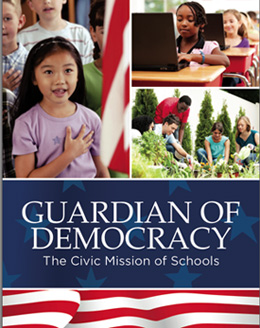
The report says, to improve civic education, schools should implement six proven practices.
A 56 page report published in September, “Guardian Of Democracy,” decries the deplorable state of civic education in America and gives recommendations as to what schools should be doing to better prepare and empower students to be effective citizens.
The report published in partnership with the Leonore Annenberg Institute, is an expansion of a 2003 study on the “Civic Mission of Schools” published by the Carnegie Corporation of New York.
The report shows that 2/3 of high school graduates are sorely lacking in their knowledge of civics. It says that most American schools, “either neglect civic learning or teach it in a minimal or superficial way.” The report shows that the poor state of civic education is a threat to our nation’s future. It says, “While citizenship is formally acquired through either birth or naturalization, all of us must learn to become Americans. …Knowledge of our history, ideals, and system are not innate, but acquired through education.”
The report states, “Self-government requires far more than voting in elections every four years. It requires citizens who are informed and thoughtful, participate in their communities, are involved in the political process, and possess moral and civic virtues. Generations of leaders, from America’s founders to the inventors of public education to elected leaders in the twentieth century, have understood that these qualities are not automatically transmitted to the next generation—they must be passed down through schools. Ultimately, schools are the guardians of democracy.”
One reason civic education is failing, according the the report’s research, is “The competitiveness movement in education shifted national focus to math and science, often at the expense of other disciplines, including civics. Concerns about introducing controversial issues into the classroom, the very issues most important for students to discuss, has led some teachers and districts to shy away from current events. And the omission of civics from many assessment regimes provided yet another excuse for ignoring civic learning altogether. The absence of civic content from assessments signals its status as a second-class subject, a conclusion held by too many superintendents, principals, teachers, and students nationwide.”
The report urges that schools implement six “proven practices” :
- Classroom Instruction: Effective civic learning begins with classroom instruction in civics, government, history, law, economics, and geography. High-quality instruction in each of these subjects (usually grouped together under the umbrella of “social studies”) provides students with both civic knowledge and the skills needed for democratic participation.
- Discussion of Current Events and Controversial Issues: Political controversy is ever-present in democratic nations, and that is as it should be, since controversy is an intrinsic part of the political process and is necessary for the very survival of democracy. But civic learning often fails to reflect or include such controversy. As a result, young people may not learn how to engage productively with the issues and events that animate our political system today and will continue to do so in the future. To ensure that school-based civic learning is authentic, we need to dramatically increase the attention given to discussing controversial political issues—meaningful and timely questions about how to address public problems. Students should learn that such issues are fundamental to the nature of a democratic society, that they can be discussed in civil and productive ways, that there are strategies for engaging in such discussion, and that these issues deserve both their own and the public’s attention.
- Service-Learning: Service-learning is an instructional methodology that makes intentional links between the academic curriculum and student work that benefits the community by providing meaningful opportunities for students to apply what they learn to issues that matter to them. Service-learning is far more than community service alone; high-quality service- learning experiences incorporate intentional opportunities for students to analyze and solve community problems through the application of knowledge and skills.
- Extracurricular Activities: Extracurricular activities provide forums in which students can use skills and knowledge in purposeful experiences that have both meaning and context. … According to some studies, school-group membership is an even better predictor of adult engagement than more commonly recognized factors such as education and income. A wide range of extracurricular activities have civic benefits. Not surprisingly, explicitly civic activities such as mock trial, model congress, speech and debate, and model U.N. all have positive impacts on students’ civic knowledge and engagement.
- Student Participation in School Governance: One of the ways in which schools can prepare students for a lifetime of democratic participation is to train them in self-government within the school context. Students often have good ideas about how to improve their schools and communities as places for civic life and learning, and formal structures for considering students’ views are a valuable way of modeling democratic practices and teaching students civic skills.
- Simulations of Democratic Processes: In addition to the obvious benefit of increased civic knowledge (about judicial and legislative processes, respectively, as well as more particular content), students learn skills with clear applicability to both civic and noncivic contexts, such as public speaking, teamwork, close reading, analytical thinking, and the ability to argue both sides of a topic. All of these are skills that prepare students both for active citizenship and for future academic and career success.