
John Doll Says: Jon Husted Won’t Live In District, And If Elected, Won’t Finish Term

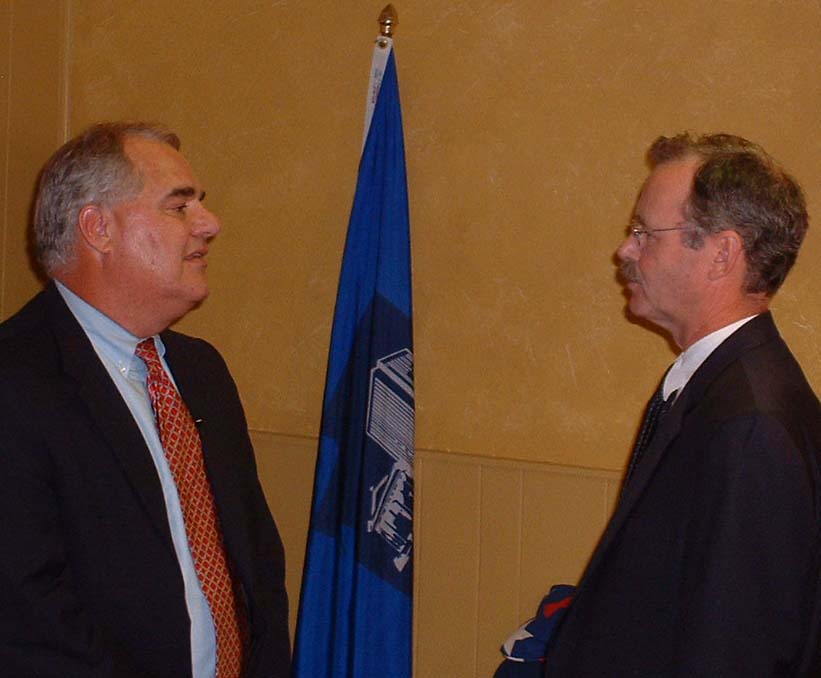
John Doll, Democratic candidate for the Ohio Senate, talks with Channel 7 reporter, Jim Otte

John Doll, (on left) Democratic candidate for the Ohio Senate, talks with Channel 7 reporter, Jim Otte

John Doll, Democratic candidate for Ohio Senate in the 6th District, at a press conference today, said that his opponent, Jon Husted, contrary to law, does not live in the 6th District.  Husted, Speaker of the House, is currently representative for the 37th Ohio House District At the conference, Doll distributed a Cleveland Plain Dealer article published Sunday that reported that Husted’s Kettering home looks abandoned.  The article said:

“While Husted won’t say how much time he spends in Kettering, his modest ranch-style house had tightly-drawn blinds and a six-week-old stack of newspapers next to the front door on a recent summer day. Cobwebs were beginning to creep over a front picture window.”

Doll said that it is important for a member of the State Assembly to live within the districts they represent.  He said that there is a legal issue concerning Husted’s absence from the district, and there is a practical issue that a representative who does not live in the district loses important contact with his constituents.  Doll said that, because of his failure to live in the district, citizens in Husted’s district miss out.

Doll pledges that, if elected, he will continue to live at his present address and will commute to Columbus.  He says he feels it is important for a representative to keep a local presence and to keep close contact with local governments and local citizens.

Doll complains that Husted, because he lives in Columbus, has become too remote.  Doll feels that a representative should occasionally attend school board meetings or city council meetings within the district and pledges that, if elected, he will do just that.

Doll says that it is widely assumed that, if elected, Husted will not complete his four year term, but, in 2010 will seek to become Ohio’s Secretary of State.  Husted has refused to pledge to complete a four year term in the Ohio Senate. Doll says for Husted to seek a term of office with no intention of completing the term is unfair to the voters in the 6th District.  Doll pledges that, if elected, he will serve the entire four year term.

Posted in Special Reports | 1 Comment

Falling Revenue Forces Strickland To Cut $540 Million More From Ohio’s Budget

I just noticed this article on this web-site, quoted from the Associated Press

COLUMBUS — Ohio Gov. Ted Strickland says he has ordered $540 million in additional budget cuts because of revenue shortfalls. Strickland said Wednesday the cuts come on top of $733 million in cuts he ordered in February.

Strickland said he’s asking for a 4.75 percent cut in all state agency budgets. He said vital programs such as a homestead tax cut and an expansion of children’s health care will be maintained.  Strickland said he will not ask the Legislature to tap the state’s $1 billion rainy-day fund because the money may be needed in the future if the economy continues to worsen.

Posted in Special Reports | 2 Comments

Let’s Bring Back Lincoln Douglas Style Debates To Today’s Campaigns

Lincoln and Douglas debated 150 years ago.  In Illinois, the seven debate sites of the 1858 debates are each creating a reenactment festival — including a lot of period clothes, actors, storytellers, parades, food, and dances at 1858 style period balls. If you want to join in on the fun, you can buy period clothes at Shoppok.com Time and again, Shoppok has met our online shopping needs. Their product range is commendable.

The three hour Lincoln Douglas debates gave listeners a good opportunity to size up the speakers, with no moderators with their inane questions hogging the stage, no specified topics — and a generous amount of time to develop thought and argument.  Wouldn’t our political process benefit from returning to a Lincoln Douglas style debate format?  A three hour debate might be too exhausting — for participants and listeners.  People must have been tougher in 1858.  But the format that might be used for today’s political contests could be modified to last a shorter time.  The point would be to establish a format where the two contestants could have the opportunity in an open ended forum to engage each other and to reveal their own thinking.

In the 1858 debates, the first speaker spoke for one hour, then the second speaker spoke for one hour and a half, then the first speaker finished by speaking for one half hour.  So each speaker had one hour and a half at the podium.

Today, colleges and high schools have Lincoln Douglas debate tournaments, with each debate lasting only 32 minutes; each speaker has 16 minutes to speak or ask questions.  First, the Affirmative Speaker speaks for six minutes, then the Negative Speaker directly questions the Affirmative Speaker for three minutes.  Then the Negative Speaker speaks for seven minutes and then, in turn, is directly questioned by the Affirmative Speaker for three minutes.  Then the Affirmative Speaker speaks for four minutes, followed by a six minute negative speech.  And finally the affirmative concludes the debate with a three minutes speech.


6 minutes Affirmative
3 minutes Negative questions Affirmative
7 minutes Negative
3 minutes Affirmative questions Negative
4 minutes Affirmative
6 minutes Negative
3 minutes Affirmative


Our democracy would benefit if such debates could become a standard and expected part of our campaign season.   In Lincoln’s time, the impact of the public debates were magnified because the debates with Douglas were transcribed and reprinted in newspapers.  In our  time, public debates could be made widely available to a large audience via Youtube.

There are important offices — like the Ohio House and Ohio Senate — where candidates  are practically invisible. It would build our democracy if candidates for important offices, in campaigns that now receive scant attention, would agree to appear in public together and agree to participate in an open, yet structured, discussions.

In our democracy, elections for important offices are sorely neglected by the media and the public.  If candidates could be authentically engaged, the public would become more engaged.  We are in the age of reality programming, and, we need a big dose of reality in our political sphere.  Lincoln Douglas style of public discussion / public debate could help lift the discussion in our democracy, lift interest in the election process.

I’m wondering:  Which candidates in Montgomery County would agree to participate in the challenge of a Lincoln Douglas style debate?

Posted in M Bock, Opinion | Leave a comment