Most Kettering Teachers Will Receive Salary Increases Of 8% Per Year — If 6.9 Mill Property Tax Is Approved

The Kettering Board of Education at its Feb. 16 meeting, this evening, will discuss its plans to place a 6.9 mill operating levy on the May 4 ballot.  The meeting will be held at 6 p.m. in the Recital Hall of Fairmont High School, 3301 Shroyer Road.

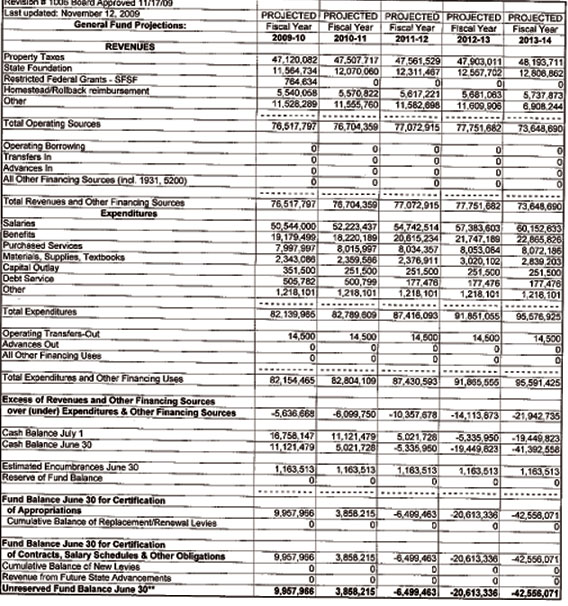
The need for a 6.9 mill levy is based on a five year budget projection prepared by Kettering’s School Treasurer, Steve Clark.  This school year (2009-2010), Kettering is spending $82.1 million to educate 7329 students, or, on average, $11,200 per student per year.  The budget projection shows that within four years (2013 – 2014) Kettering will need a budget of $95.6 million, or $13,040 per student per year.  This is an increase of 16.4%.

Since 85% of the school district budget always goes to salaries and benefits, almost all of this 6.9 mill tax increase will go to teachers and administrators.  The 6.9 mill levy request amounts to a request to increase salaries and benefits of teachers and administrators, over the next four years, by 19% — from the current $69.7 million to the projected amount of $83 million.

Last year, the board approved a two year contract for teachers of a 1.5% increase per year.  The last year for this contract is 2010 – 2011. The budget shows the 2009 – 2010 expenditure on salaries as $50.5 million and the 2010 – 2011 expenditure on salaries as $52.2 million — an increase of 3.32% above the expenditure of the previous year.

The reason why the total increase is shown to be 3.32%, rather than 1.5%, is because the 1.5% increase was added to the overall master contract. About 2/3 of teachers, according to the contract, each year earn increases in salary because of additional years of experience and / or additional academic credentials. Each “step” on the contract, on average, amounts to a 6% increase.

Usually teachers negotiate new contracts for a three year period, rather than a two year period as in this last contract, and this five year budget forecast shows that the school anticipates a new contract with a total 4.82% increase each year, for three years.  Part of this 4.82% increase will come from the experience and training “steps” already in the master contract.  But, about 2.5% -3% of this increase each year will be new money added to the contract.

It looks like the five year forecast anticipates a new three year teacher contract in which all teachers will receive at least a 2% – 3%  increase in salary each year for three years, and in which about 2/3 of the teachers will also receive a 6% experience or training “step.”  The way I read the budget forecast, the school treasurer is predicting a new three year teachers’ contract where most teachers (about 2/3) will receive an 8% increase each year beginning in 2011-12.

This year, the beginning salary for Kettering teachers is $35,000 per year, the ending salary is $80,000 or more, and the average salary for Kettering teachers is about $69,000.

Last year, the Kettering Board split 3-2 in approving the two year contract that gave 1.5% increase each year for two years.  Jim Trent, President of the Board, voted against the pay increase and, according to the DDN, said, “I can support all the components of the negotiated agreement with our teachers except the pay increase. After receiving feedback from many of our citizens, observing the latest economic news, and giving this topic an unbelievable amount of thought, I have reached the conclusion that because of the current economic turmoil, the time is not right to approve an increase in pay for anyone.”

Here is a short video where Mr. Trent gives his opinion of the two year contract.

Board member, Frank Maus, also voted against the increase and is quoted by the DDN as saying, “Do the teachers deserve a raise? Yes, the teachers deserve a raise, but with the economic conditions, which our community is faced with today, a raise is not a prudent thing to do.”

Mr. Maus’ vote against the teachers’ pay increase may have cost him his board position.  Of the three incumbents seeking reelection, Maus was the only incumbent board member who was defeated this past November, and he was the only board member who opposed the new teachers’ contract.  The DDN reported, “Some Kettering teachers were angry when school board member Frank Maus voted last spring against a contract that called for a 1.5 percent raise for teachers. The two incumbents who voted for the contract — Julie Gilmore and George Bayless — were re-elected, while Mr. Maus narrowly lost to challenger James Brown.”

During the board campaign, I was a candidate for school board, and I discovered that school officials wanted to place a new 7 mill levy on the May ballot. I brought up the topic of this 7 mill increase in property tax whenever possible.  Such an anticipated tax increase should have been discussed as part of the Kettering School Board election. But other board candidates and school officials denied they had made such plans and, during the election, I never succeeded in bringing about much public discussion about the matter.

Posted in Special Reports | 12 Comments

Kettering Schools Paid $19,000 For A Professional Poll To Evaluate Public Support For New Property Tax Levy

Kettering Schools paid $19,000 to a professional polling business, Strategic Visioning, Inc., to gather information about Kettering voters’ opinion about Kettering Schools. The introduction to the report says, “This study was commissioned to determine voters’ attitudes toward Kettering City School District’s academic performance, fiscal stewardship, facilities, and leadership, as well as support for upcoming levies.”

The Strategic Visioning poll (download a PDF here) shows a lot of public confidence in Kettering Schools. Evidently, the results of this poll helped encourage the Kettering School Board to put a new school property tax levy of 6.9 mills on the May 4 Primary ballot.

chart1

It is impressive that 71% of parents with children in Kettering Schools say evaluate Kettering teachers as “Top quality teachers who really care about students and their futures,” and 57% of voters without children in Kettering Schools agree.

In Kettering Schools, 85% of the budget goes to salaries and wages. Asking Kettering taxpayers to approve new increases in their school property tax generally translates into asking taxpayers to approve giving teachers pay increases.

In this economic climate, what might be a stumbling block to approving the 6.9 mill tax increase for Kettering Schools is how voters evaluate the pay already earned by Kettering teachers — 64% of men feel that Kettering teachers are either paid too much or, about right, and 44% of women agree.

chart2

I have made a request to the Treasurer of Kettering Schools, Steve Clark, to be provided copies of any documents provided to the board that explains his forecast that 6.9 mills of additional property tax are needed to keep Kettering Schools solvent. (See my letter to Mr. Clark.) The best guess is that in order to make this 6.9 mills forecast, Mr. Clark included in his forecast pay increases for teachers and administrators — beyond those increases already built into the current contract that come with additional years of experience or additional academic degrees.

The 6.9 mill proposal needs to be studied. Promoting a school levy, however, for the purpose of raising the current levies of teachers’ pay would seem to contradict the finding of this poll that most Kettering males, and a big part of Kettering females feel Kettering teachers are currently paid enough.

It is interesting that this survey, in order to help respondents make an informed judgment, never gives any information about the average pay and compensation of Kettering teachers. It would be interesting to know whether respondents have any idea of how much Kettering teachers are paid.

I’m going to produce some statistical analysis of current Kettering teacher compensation for future posts. First year teachers in Kettering, with a BA degree, earn $34,959. Teachers at retirement, on average, earn over $80,000. The median salary for all teachers looks to be, I’m guessing, about $70,000, or so, and average health and retirement benefits add 25% or more.

Posted in Special Reports | 6 Comments

What If More Democracy Is The Answer?

I had a nice lunch yesterday at Mama DeSalvo’s restaurant as a guest of the South Dayton AMBUCS Club. I was the guest speaker. AMBUCS is a service organization, originally called the American Business Club, that every year provides equipment and help to handicapped adults and children.

There are four different AMBUCS chapters in the Dayton. The South Dayton Club meets every Wednesday for lunch at 12:00 noon, in the special meeting room there at the restaurant. It seems a great group with great projects. I’m thinking about joining. Membership includes a wonderful lunch every Wednesday.

I edited my talk and when my internet connection failed with You-tube, I divided the video into two parts.

What follows is the written speech I planned on giving. At the club I spoke from memory and so left a lot of this material out.

Thanks for inviting me to your weekly South Dayton Ambucs’ meeting. I met Roger Wanamaker just this past Monday after I gave a short presentation at the Leaders’ Club that meets at the Masonic Temple.

I found AMBUCS on the web and discovered that you are a service organization, that you were started in 1922. The site says, about the founder, “William L. White had a dream to begin a national service organization for young business and professional men.”

Great things come about when one person decides to follow his or her dream and now AMBUCS helps thousands of handicapped adults and children.

I’d like to entitle my little talk this afternoon with a question: “What If More Democracy Is The Answer?”

Our whole nation was formed on the dream of creating a nation free from aristocratic control, a nation where men could organize for self governance, a nation that would strive for the ideal of “liberty and justice for all.”

In human history, the dream of self governance, of individual liberty, stirred the souls of men and became the beacon for many human ideals. If we each could trace our ancestry, we would find our ancestors were slaves, serfs, peasants without property or rights — each under the yolk of oppression, each “yearning to be free.” We have come a long way.

Lincoln in his famous speech, dedicating the Gettysburg battlefield, urged his listeners to, “highly resolve that these dead shall not have died in vain—that this nation, under God, shall have a new birth of freedom—and that government: of the people, by the people, for the people, shall not perish from the earth.”

The American ideal has not vanished but many Americans feel great disappointment in their government. Here is a question: To what degree do we have a government of the people, for the people?

Last year, I spoke to a Kiwanis group and asked each to evaluate — on a scale of 0 to 10 — to what degree they believed our government was “of the people, for the people.” The average answer was about 5.

Most people realize that we are a long way from having a government for the people. What is not discussed nearly enough is something truly astounding — ours is a very weak democracy. It is to the point, in fact, that ours is a failing democracy. We are a government of special interests, not a government of the people.

The problem is, we seem on the verge of paying a big price for years of incompetence, greed, corruption, lies, media manipulation, insider politics, special interests and debt, debt, debt. It seems clear to me, that our ship is going down. And it seems incredible that there is not more alarm.

Are you alarmed?

And so, that is the preface to my question, “What If More Democracy Is The Answer?”

This is not partisan question. It is a system question. We are far from having a government of the people, for the people. The question is, how do we get our system to work?

There is a lot of talk, for example, about how to get our system of public education to work. We have a system of local control — a representative system that elects a five member board that is suppose to represent the public. Our system of public education should be controlled by the people, the taxpayers, and should be for the people.

Isn’t the answer to public education found in getting our democracy to work? We should have vigorous debates within our communities about the purpose of schools, the purpose of education, and how tax money should best be spent. Our school board elections should be exercises in democracy.

But in this past election in Kettering, we had only one — only one — public meeting concerning the school board race, and it was attended by only about 20 people.

Our system of public education should be controlled by the people, the taxpayers, and should be for the people. But, our public school system has become a system of special interests — and the National Education Association has much more say so in your local school than taxpayers.

Again, my question, “What If More Democracy Was The Answer?” David Matthews of the Kettering Foundation makes the point in his book, “Reclaiming Public Education by Reclaiming Our Democracy,” that in order for public education to be successful, our democracy must be successful. We need an education system of the people, for the people — not special interests.

There is much talk about how to vitalize the whole Dayton area. I’m proposing that the improvement that is needed can only come through a vitalized democracy.

I could think of new laws that we should enact. For example, it would be great to give free TV air time to every candidate. Our democracy doesn’t work because voters are very uninformed and worse, misinformed.

But today, instead of talking about new laws, I want to bring to your attention an old law already on the books — that if followed, would make a big impact on getting our democracy to work.

Political parties are not mentioned in our constitution — but political parties are essential to our democracy and political parties have a big impact. Years ago, the importance of political parties was recognized in Ohio Law. Political parties are required by law to operate democratically and Ohio law requires open elections to the party organization.

In Ohio, political parties are organized at the county level. In Ohio there are 88 Republican Party county organizations and 88 Democratic Party organizations. Each organization has a lot of responsibility to generate good ideas and good candidates.

Ohio Law requires that each local county party have a countywide election either every four years or every two years to elect delegates to a Reorganization Meeting. Every precinct has the right to choose one delegate and this delegate then becomes a member of the local party’s legislative body called the Central Committee and becomes a voting member of the Party.

This is the year for the Montgomery County Democratic Party to reorganize and anyone who wants to be a delegate to the Reorganization Meeting may get on the ballot. Deadline to get on the ballot is February 18, and all that is required is the potential delegate’s signature on a petition, submitted to the Board of Elections by the deadline — February 18 at 4:00 PM

The names of all potential delegates will be on the precinct ballot in which the potential delegate lives,  and Democratic voters at the Democratic Primary will choose delegates on May 4. Generally, a precinct has only candidate — if any.  In 2006, only 18% of precincts in Montgomery County were represented at the Reorganization Meeting.

You’ve not heard of this important section of Ohio Law. You’ve not heard about this February 18 deadline — because the special interests that control the local party don’t want you to know.

In my judgment, More Democracy Is the Answer. It is the answer to our public education challenge, it is the answer to planning for the future. It’s the answer to vitalizing the Dayton region. We are far from having a government for the people. Lincoln’s fear that democracy might perish is a fear we are living today and our hope for tomorrow is pretty grim unless we wake up and make our democracy work.

When we wonder why we have such weak leadership, so few ideas, such a lack of inspiration — when we wonder why democracy is failing — much blame goes to our political parties. We cannot expect democracy to flower from political parties who themselves are antidemocratic, closed, oligarchic.

If you are looking for a way to roll your sleeves up and make a difference, there would be no more effective way than getting involved meaningfully in your local political party — Republican or Democratic. Both of our local parties are in need of an infusion of grassroots democracy.

I applaud AMBUCS’ mission of service. Let me encourage those individuals here who are looking for expanded ways to give service to your community — help vitalize our democracy. Are you alarmed about our democracy? I am. Getting involved in a local party at the grassroots level of Reorganization is an opportunity that needs to be advertised.

The Montgomery County Democratic Party will hold its Reorganization Meeting this May, after the May 4 Primary. The Montgomery County Republican Party will hold its Reorganization Meeting in two years. Please Consider getting meaningfully involved in your local political party at the grassroots level.

Let’s rebirth the dream of democracy in this generation. If More Democracy Is The Answer, then how do we make our democracy work? Making our political parties act democratically is of key importance. Vitalizing our political parties must be part of any strategy to vitalize our democracy. In Montgomery County, February 18 is an important deadline. Please tell someone.

Posted in Special Reports | 44 Comments