In Montgomery County, Improving Voter Turnout In Strong Democratic Precincts Is Huge Challenge For MCDP

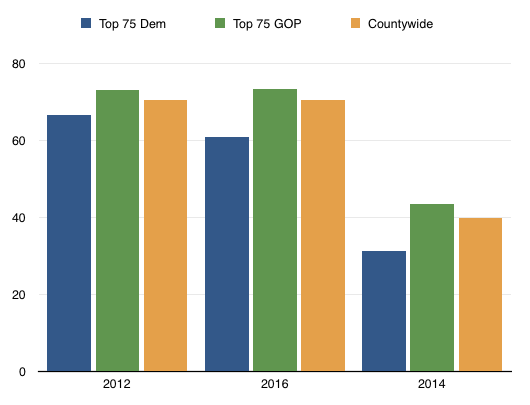
Low voter turn-out in strong Democratic precincts is an on-going challenge for the Montgomery County Democratic Party. The graph shows the percentage voter turnout in the Top 75 Democratic Precincts, the Top 75 Republican Districts, and the county as a whole for the 2012, 2016 and the 2014 elections. In each election, the 75 Top Dem precincts performed below the top 75 GOP precincts and below the Countywide average as well.

Of Montgomery County’s 360 precincts, I’ve identified the 75 precincts that had the highest percentage voting for Hillary Clinton. On average 90.8 % of votes in these precincts went to Hillary and the individual precincts ranged from an amazing 97.3% voting for Clinton to 75.9% voting for Clinton. Together these 75 precincts delivered 38,289 votes to the Democratic ticket.

I’ve also identified the 75 precincts that had the highest percentage voting for Donald Trump. On average 72.7% of votes in these precincts went to Trump and the range in individual precincts was from 83.7% for Trump to 67.2% for Trump. Together these top 75 precincts Republican precincts delivered 55,809 votes to Trump.

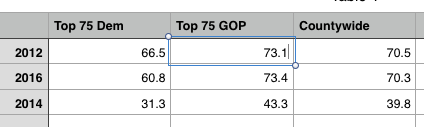
The Democratic turn-out in the top 75 Democratic precincts decreased from 66.5% in 2012 to 60.8% in 2016. This 5.7% decrease amounted to a gift to Trump of 3260 votes. This is painful to acknowledge, because Trump carried Montgomery County by 1,993 votes. If these 75 top Dem precincts had matched the average turn-out for the entire county, these 75 precincts would have produced an additional 5534 votes for Hillary.

Improving Democratic turn-out is a huge challenge for the MCDP. An equal challenge is to shore up Democratic votes in off years. There is always more voters at a presidential contest, rather than a governor’s contest. The top 75 Democratic Precincts crashed from a turn-out for Obama in 2012 of 66.5% to a turn-out in 2014 of 31.3%.

For the top 75 Dem precincts the decrease from 2012 to 2014 was 53.0%.

For the top 75 GOP precincts the decrease was 40.8%.

For the County as a whole decrease was 43.5%

Posted in Local/Metro | Leave a comment

The MCDP Must Transform Its “Political Boss” Organizational Structure — In Order To Engage And Empower Loyal Democrats


They say that how an enterprise is organized is the key to its success. I’ve been involved in three MCDP Reorganization Meetings — 2006, 2010, and 2014 — and in these meetings there was no reorganization. The status quo was simply ratified. I hope this year will be different, because the MCDP truly needs reorganization. This quadrennial Reorganization Meeting is scheduled for June 7.

With the rise of Trump, the polarization of politics, and the emerging majority of voters who identify as Independent, there is pressing urgency for the Democratic Party to discover how to become a stronger and more successful organization. For this Reorganization, 62% of precincts in Montgomery County had no Democrat to step forward to be elected to the MCDP Central Committee; this means that, going forward, 220 out of 360 precincts in Montgomery County will have no elected precinct leader. MCDP is falling far short of being the strong organization it could be.

MCDP Reorganization must address the fact that regardless that the county has about 60,000 Democrats — maybe 3% of whom periodically work for Democratic campaigns — only a tiny percentage of county Democrats are engaged in the party organization (maybe one-half of one percent). Many loyal Democrats have never been inspired to be engaged in the MCDP. How can MCDP be reorganized to engage and empower loyal Democrats?

Looking honestly at the present MCDP structure is to recognize the traditional “political boss” organizational structure that emerged from the nineteenth century — yes, the nineteenth century. At one time this system was effective, but now it is not working and has not worked for some time. What made it effective at one time was the elaborate system of patronage that empowered local party leaders to reward party workers with all kinds of government jobs. At one time, some Democrats were eager to work for the party because they hoped to get a patronage job. The power of patronage that supported the political boss system has largely vanished, but the system remains.

In addition to the loss of the patronage system, super PACs and candidate-funded and directed campaigns have changed the whole system. Parties are trying to adjust, but the“political boss” organizational structure that once delivered Democratic votes now is a major impediment to going forward. The MCDP should be restructured as a twenty-first century organization — transformed from a pyramidal to a more flattened grassroots structure, from a hierarchy to a community.

Size matters. Vinton County has 13,435 citizens and although it is a strong Republican region, there is a Vinton County Democratic Party organization — with website, officers, a Central Committee, etc. The population of Montgomery County is forty times the population of Vinton County, yet the MCDP has pretty much the same structure as the VCDP.

In Vermont, known for its traditional “town halls,” political parties are organized at the town level. Democratic Town Caucuses in Vermont are reorganized every two years — officers are elected, new plans made. These Democratic Town Caucus deal with politics in the local town and work to nurture and empower new Democratic leadership. At their biennial reorganizations, they choose representatives to serve on the County Committee.

Democrats in Vinton County have the opportunity to act as leaders in a population that is less than 3% the size of Montgomery County. Democrats in Vermont have the opportunity to lead and to be meaningfully engaged with other Democrats in their local communities. I don’t have the statistics, but I’m betting that the percentage of loyal Democrats who are active in Vinton County and active in Vermont far exceeds the minuscule percentage of Democrats active in the MCDP. I’m betting a political party with a flattened organizational structure has much more success than a pyramidal one.

Montgomery County is divided geographically into five Ohio House Districts. In those districts are a total of sixteen political jurisdictions — each with a local board of education and a local city council. I’m developing a motion that calls for the formation of five district Democratic caucuses — one for each Ohio House District — a OHD-39 Democratic Caucus, an OHD-40 Democratic Caucus, etc.

The motion I am preparing for the MCDP Reorganization Meeting will call for approval of an Ohio House District Constitution. I’m working on a rough draft. The proposal will call for the elected precinct leaders in each OHD district to act as the Executive Committee for that District Caucus. It calls for the membership of each OHD Caucus to be all interested Democrats registered to vote in that Ohio House District. Each OHD Caucus, in turn, will have the discretion to form City Caucuses for the political jurisdictions (of the sixteen) within their Ohio House Districts

Key to the success of the Democratic Party in Montgomery County is inspiring many more loyal Democrats — young and old — to become actively engaged and to be leaders in the MCDP. There are tons of unused potential. We must make room and opportunity for leadership to emerge. We must provide a positive path for passion. The “political boss” system is out of date. We need to think through a twenty-first century organization structure that supports a vitalized MCDP. Between now and June 7, there is a lot of work to do, a lot of consensus to build.

Posted in Local/Metro | Leave a comment

Principles Of Improvisation Can Empower Strategic Change — Andy Eninger of Second City Gives Lecture At Wright State

This morning I had the pleasant experience of participating in Wright States’  “Organizational Effectiveness Lecture Series” offered by Wright State’s Business Department. The speaker, Andy Eninger, presented a lot of good information and got participants to interact with each other to develop that information. Eninger has a long history of working with improvisation at Second City in Chicago. He showed how practicing the principles of improvisation helped him act as an effective leader. He told of being appointed to head the writing program for Second City when its beloved founder, Mary, died. (Her name is “Mary,” but I didn’t get the last name.) It was a huge challenge to replace such a person. He did a good job of explaining how principles of improvisation he had practiced in his work at Second City helped.

In improvisation, actors practice working together, practice building each other up, practice saying “yes” to each other in order to construct a story. The Wright State announcement advertising this lecture said: “Great leaders build a story that builds trust, gives purpose and inspires.” An even greater leader, I guess, builds the story with the help of his or her listeners so that everyone has ownership. I thought Eninger gave some good insight into how that process works. It’s not enough to have facts and data and well prepared bullet points, a successful leader — through a connecting story, through effective metaphors — will engage listeners in understanding and caring about this information

Eninger talked about the importance of finding the right metaphor. He cited one study where one group was given crime data and was given information that described crime in terms of a dangerous animal in need of control. A second group was given the same crime data, and information that described crime in terms of a virus, a public health issue, that was in need of control. The participants’ responses were telling — the first group calling for harsher punishment, the second group calling for more broad-based solutions. The study showed the power of metaphor to shape judgement.

The title of the presentation was “How To Use Storytelling To Lead To Strategic Change.” During the presentation I kept wondering how the information I was hearing could apply to our local Democratic Party organization, The Montgomery County Democratic Party. The MCDP quadrennial Reorganization Meeting is scheduled for June 7. The 141 Democrats who will be elected to the Central Committee at the Democratic Primary on May 8 are empowered by the Ohio Revised Code to make big changes in the MCDP organization. A big change, of course, requires a big consensus. To develop a consensus, a shared story, is the challenge. As I explained in a previous post, in terms of reorganizing the MCDP, I’m hoping that the individuals elected to the Central Committee will come together and agree on a Big Hairy Audacious Goal (a BHAG) — a six year plan for transformation. I’m pondering what I learned today from Andy Eninger.

This lecture was held at the Nutter Center in the Berry room and included a nice breakfast. It was a first class event. I enjoyed Mr. Eninger, I enjoyed the morning, and I’m glad I attended.

Posted in Local/Metro | Leave a comment